
Smelly candles are scented candles that release off or unpleasant odors due to material flaws, poor formulation, or incorrect burning rather than the intended fragrance. The causes range from petroleum-based paraffin wax and oversized wicks to fragrance oils added at the wrong temperature and improper storage. Every one of these factors is preventable. At HAUS OF SMELL, the studio’s 100% natural, vegan botanical approach, hand-poured in Manhattan, addresses each failure point before the candle ever reaches you. Understanding what goes wrong is the first step toward choosing aromatic candles that actually smell the way they should.
What makes smelly candles go wrong?
The wax is the foundation of every candle’s scent performance. Paraffin, a petroleum byproduct, burns with a higher soot output than natural alternatives. That soot carries its own acrid odor, which competes with and often overwhelms the intended fragrance. Soy wax burns 30–50% longer than equivalent paraffin candles. That longer burn also means a steadier, cooler flame that releases fragrance more evenly rather than scorching it off in the first hour.
Beeswax sits at the premium end of the natural spectrum and burns cleanly — but it is an animal product, which is why vegan makers work with plant waxes instead. Soy wax is neutral, accepts a wide range of fragrance loads, and is the workhorse of the vegan candle world. Blends that combine soy with coconut can improve both scent throw and surface appearance. The problem arises when manufacturers add synthetic hardeners or UV stabilizers to those blends, which disrupt combustion and introduce off-odors.
| Wax type | Fragrance load capacity | Burn characteristics |
|---|---|---|
| Paraffin | High | Fast burn, heavy soot, strong initial throw |
| Soy | Moderate to high | Slow, clean burn, even scent release |
| Beeswax (not vegan) | Moderate | Very clean, long burn, animal-derived |
| Coconut wax | High | Smooth, creamy burn, excellent cold throw |
| Soy/coconut blend | High | Balanced burn, reduced soot, rich throw |
Pro Tip: If your candle produces black smoke rings on the jar, the wax or wick is the culprit, not the fragrance. Switch to a natural wax base before adjusting anything else.
How does wick size affect candle scent quality?
The wick controls how much heat reaches the wax pool, and heat is what vaporizes fragrance. Get the wick wrong and the scent goes wrong with it. Under-wicked candles fail to create a proper melt pool, which prevents fragrance oils from vaporizing and produces a weak or flat scent. Over-wicked candles burn too hot, create heavy soot, and push unpleasant smoke odors into the room instead of the intended fragrance.
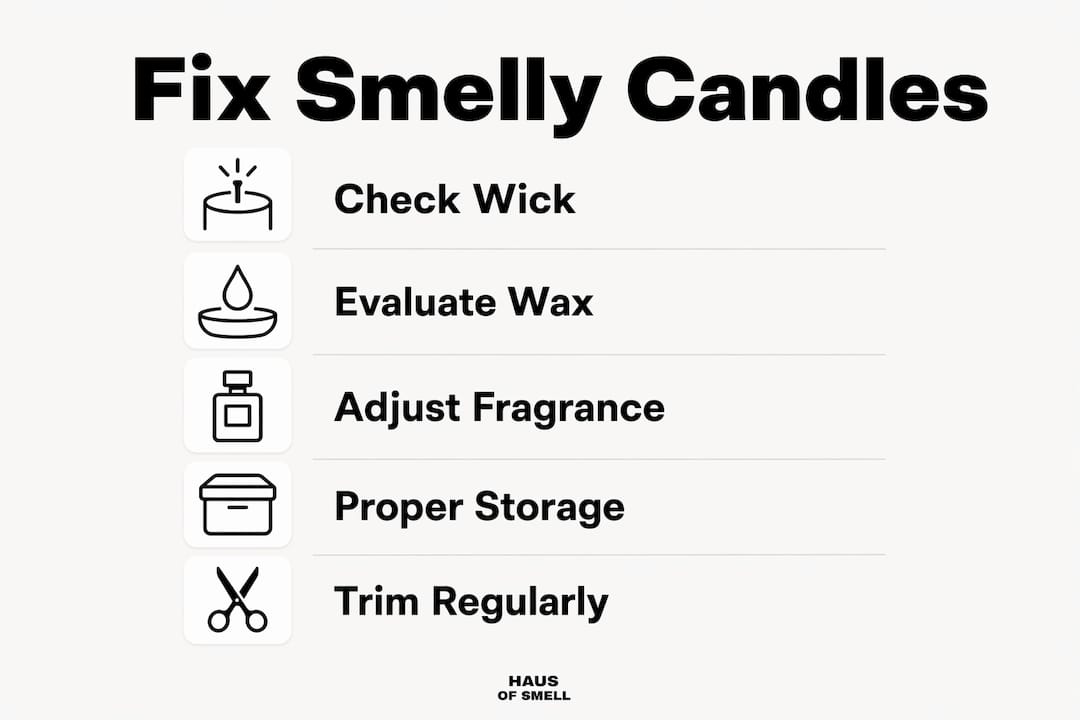
Wick mushrooming is one of the clearest signs of trouble. Carbon buildup at the wick tip causes soot and odor and is prevented by correct wick sizing and regular trimming. Trimming the wick to ¼ inch before every burn is the single most effective maintenance habit. A shorter wick produces a steadier flame with less black smoke and better fragrance vaporization.
The first burn matters more than most people realize. Burning a new candle until the melt pool reaches the edges of the jar, typically 2–3 hours, sets the memory of the wax. Skip that step and the candle will tunnel down the center on every subsequent burn, leaving unmelted wax on the sides and a permanently weakened scent throw.
Here are the four wick practices that prevent odor problems:
- Trim to ¼ inch before every single burn, without exception.
- Allow a full melt pool on the first burn to prevent tunneling.
- Burn for no more than 4 hours at a time to avoid overheating the wax.
- Keep the candle away from drafts, which cause uneven burning and soot spikes.
Pro Tip: Olfactory receptors desensitize after 2–3 hours of continuous scent exposure. If your candle suddenly seems odorless, step outside for 10 minutes. The fragrance is almost certainly still there.
Do fragrance oils cause off-odors in candles?
Fragrance oil quality is the most underestimated variable in candle scent performance. The temperature at which fragrance oil is added during manufacture determines whether the top notes survive. Fragrance oil added above 185°F (85°C) can burn off delicate top notes before the candle even reaches the customer. What remains smells flat, sharp, or chemically off, which is the exact complaint most people associate with cheap scented candles.
Scent stratification is a related problem. Fragrance oils can separate from wax over time when formulation or temperature control is improper. The result is uneven scent distribution: the candle smells strong in the first burn, then faint or strange in subsequent ones. This is a manufacturing defect, not a storage issue.
Natural botanical fragrances from sources like resins, woods, and spices produce complex, rich scent profiles that are less prone to off-odors than synthetic fragrance compounds. HAUS OF SMELL draws from a 212-material botanical library, including ingredients like labdanum resin, cedarwood, and black pepper, each of which contributes a specific, stable note rather than a synthetic approximation. The result is a candle that smells coherent from the first burn to the last.
Additives compound the problem when used incorrectly. Wrong additive usage disrupts the melt pool and combustion, weakening fragrance release and causing odor issues. Common offenders include vybar (a polymer used to harden wax), UV inhibitors, and stearic acid used in excess. Each one changes how the wax burns and how fragrance vaporizes.
Key signs that fragrance oil or additives are the problem:
- The candle smells fine cold but turns sharp or chemical when lit.
- The scent changes noticeably between the first and third burn.
- A greasy or oily residue appears on the wax surface (fragrance oil separation).
- The flame flickers and spits, indicating fragrance oil that was not fully bound to the wax.
How does storage affect candle fragrance and odor?
Storage is where many candles fail before they are ever lit. Heat, light, and air exposure all degrade fragrance molecules, causing them to evaporate, oxidize, or break down into compounds that smell wrong. Ideal storage is below 75°F, in dark places, with sealed containers to preserve fragrance integrity over time. A candle left on a sunny windowsill for a month will smell noticeably weaker and potentially off when finally burned.
Temperature swings are particularly damaging. Rapid cycling between warm and cool conditions causes the wax to expand and contract, which can push fragrance oil to the surface. That surface “sweat” is not a safety issue, but it signals that the fragrance is migrating out of the wax rather than staying bound within it.
Practical storage habits that protect candle scent:
- Store candles with their lids on or wrapped in tissue paper to limit air exposure.
- Keep them away from radiators, sunny shelves, and kitchen heat sources.
- Avoid storing candles near strong-smelling items, since wax absorbs ambient odors.
- Use candles within 12 months of purchase for peak scent performance.
- If a candle has been stored for a long time, burn it briefly to check scent before using it in a meaningful setting.
Key Takeaways
The quality of a candle’s scent depends entirely on the harmony between wax type, wick size, fragrance formulation, and storage conditions, and fixing any one of these factors produces a measurable improvement.
| Point | Details |
|---|---|
| Wax type determines scent quality | Natural plant waxes like soy and coconut burn cleaner and release fragrance more evenly than paraffin. |
| Wick size controls heat and odor | Trim to ¼ inch before every burn to prevent soot, mushrooming, and off-odors. |
| Fragrance oil temperature matters | Oil added above 185°F burns off top notes, causing flat or chemical-smelling candles. |
| Storage protects fragrance integrity | Keep candles below 75°F, sealed, and away from light to prevent scent degradation. |
| Botanical ingredients reduce off-odors | Natural resins, woods, and spices produce stable, complex scent profiles without synthetic off-notes. |
What we have learned from making candles in Manhattan
The most common complaint we hear is some version of “my candle smells great in the store but strange at home.” Nine times out of ten, the problem is the first burn. People light a candle for 20 minutes, blow it out, and then wonder why it tunnels and smells faint or waxy every time after that. The wax has memory. That first burn sets everything.
The second thing we have learned is that synthetic fragrance compounds are doing a lot of heavy lifting in the mass market, and they are not doing it well. A synthetic musk can smell fine at room temperature and turn sharp and headache-inducing when combusted. Natural botanical materials behave differently. Labdanum resin deepens as it burns. Cedarwood becomes warmer. The scent arc of a well-made botanical candle is actually more interesting at the end of the burn than at the beginning.
We are also skeptical of very high fragrance loads. A candle loaded with 12% fragrance oil sounds impressive, but if the wax cannot bind that much oil properly, the excess migrates to the surface and creates exactly the kind of off-odor problem people are trying to avoid. At HAUS OF SMELL, we calibrate fragrance load to what the wax can actually hold, not to what sounds good on a label. The result is a candle that smells right, consistently, from the first burn to the last pour of wax.
— HAUS OF SMELL
Natural botanical candles that get it right

HAUS OF SMELL hand-pours every candle in Manhattan using 100% natural, vegan plant-wax blends and botanical fragrance materials drawn from a 212-ingredient library of resins, woods, spices, and botanicals. No synthetic compounds. No petroleum-based wax. No animal products. Every wick is sized to the specific wax and fragrance combination, so the melt pool, the scent throw, and the burn arc all perform as intended. You can browse the full botanical note index to understand exactly what goes into each scent before you buy. For customers who want complete ingredient transparency, the notes and ingredients page breaks down every material used across the collection. If you are ready to replace a candle that has been disappointing you, the natural botanical candle collection is the place to start.
FAQ
Why does my scented candle smell bad when lit?
A candle that smells off when burning usually has a wick that is too large, a paraffin wax base producing soot, or fragrance oil that was added at too high a temperature during manufacturing. Switching to a natural wax candle with a correctly sized wick resolves most cases.
How do I stop my candle from producing black smoke?
Trim the wick to ¼ inch before every burn. A shorter wick produces a steadier flame with significantly less soot and better fragrance vaporization, which eliminates most black smoke issues.
What is wick mushrooming and why does it cause odor?
Wick mushrooming is carbon buildup at the tip of the wick caused by an oversized wick or heavy fragrance oils. It produces soot and unpleasant smoke odors and is prevented by trimming the wick and choosing a correctly sized wick for the wax diameter.
How long do candles stay fresh in storage?
Candles stored below 75°F in sealed containers away from light retain their fragrance integrity for up to 12 months. Heat, light, and air exposure cause fragrance molecules to evaporate or oxidize, which weakens or alters the scent.
Why does my candle smell different after the first burn?
Fragrance stratification, where fragrance oil separates from the wax due to improper formulation or temperature control during manufacturing, causes scent to change between burns. This is a production defect. A well-formulated candle using correctly bound fragrance oil should smell consistent across every burn.