
Petrichor scent is the earthy, fresh aroma that emerges when rain falls on dry soil, created primarily by a bacterial compound called geosmin and plant oils accumulated during dry periods. This distinctive smell results from raindrops striking the ground and releasing these compounds into the air as aerosols, which our noses detect with remarkable sensitivity.
The word itself carries poetry. Coined in 1964 by Australian researchers Isabel Bear and Richard Thomas, petrichor combines the Greek words petra (stone) and ichor (the fluid in the veins of gods). This nomenclature captures something essential about the experience: it feels ancient, elemental, almost sacred.
What causes the petrichor scent when it rains?
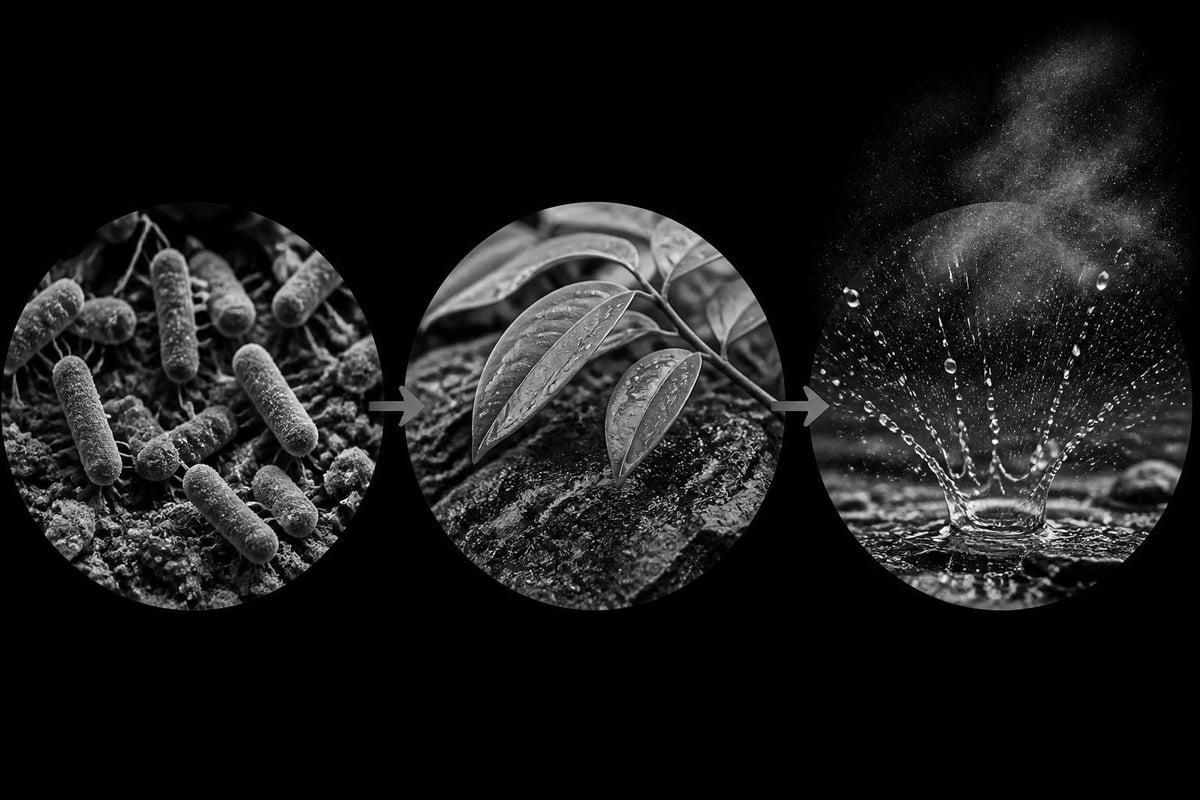
The petrichor scent originates from two primary sources working in concert: geosmin produced by soil-dwelling bacteria and plant oils that accumulate on surfaces during dry weather. When raindrops hit the ground, they create tiny air bubbles that burst and release these compounds into the atmosphere as aerosols, which travel on air currents to reach our olfactory receptors.
Research from McGill University demonstrates how actinobacteria, specifically those in the genus Streptomyces, produce geosmin as a metabolic byproduct. These microorganisms thrive in moist soil conditions but become dormant during dry spells. When rain arrives, it reactivates their metabolic processes, triggering geosmin release.
The mechanism of dispersion proves equally fascinating. High-speed photography reveals that raindrops trap tiny air pockets upon impact. These pockets fracture into smaller bubbles that rise through the water droplet and burst at the surface, ejecting aerosol particles containing geosmin and plant oils into the surrounding air.
The role of geosmin in earth's aroma
Human noses detect geosmin at concentrations as low as five parts per trillion. This extraordinary sensitivity exceeds our ability to detect many other organic compounds. The evolutionary advantage remains unclear, though some researchers theorize it helped our ancestors locate water sources or fertile soil.
Geosmin contributes a musty, earthy quality to the petrichor scent profile. It appears not only in rain-soaked soil but also in beets, certain wines, and muddy-tasting freshwater fish. The same compound that makes rain smell pleasant can render drinking water unpalatable when present in higher concentrations.
Plant oils add complexity to the equation. During dry periods, vegetation releases oils that coat nearby rocks, soil particles, and pavement. These aromatic compounds vary by region and ecosystem, which explains why petrichor smells different in a pine forest versus a desert landscape versus an urban environment.
Why do humans find the petrichor scent appealing?
Humans find petrichor appealing because it signals life-sustaining rain, triggering positive associations encoded through both evolutionary history and personal experience. The scent activates memory centers in the brain, often evoking specific moments from childhood or significant life events tied to rainstorms.
Our relationship with this aroma transcends simple olfactory pleasure. Studies on natural scents show that petrichor can reduce stress markers and improve mood states. The mechanism likely involves both psychological associations and direct neurological responses to the chemical compounds themselves.
Cultural factors amplify biological predispositions. Many traditions celebrate the first rain after drought. In India, the arrival of monsoon rains holds profound cultural significance. Australian Aboriginal peoples use smoke from burning plants to simulate petrichor in ceremonies. These practices reinforce positive associations across generations.
| Petrichor Component | Source | Scent Quality | Detection Threshold |
|---|---|---|---|
| Geosmin | Soil bacteria | Earthy, musty | 5 parts per trillion |
| Plant oils | Vegetation | Varies by species | 10-100 parts per billion |
| Ozone | Lightning | Sharp, clean | 10 parts per billion |
The timing matters as much as the composition. Petrichor intensity peaks when rain follows extended dry periods. The longer soil remains parched, the more geosmin accumulates in dormant bacteria and the thicker plant oils coat surfaces. The first rain releases this stockpile all at once.
How does petrichor differ from other rain-related smells?
Petrichor differs from other rain-related smells in its earth-based origin, while ozone creates the sharp, metallic smell before storms and wet pavement produces distinct urban aromas through different chemical processes. Each rain-associated scent emerges from separate mechanisms occurring at different stages of precipitation events.
Ozone forms when lightning splits oxygen molecules, creating that distinctive clean smell before thunderstorms arrive. This triatomic oxygen (O₃) has a sharp, almost electric quality that contrasts sharply with petrichor's earthy warmth. The chemical differences between these scents reflect entirely separate atmospheric processes.
Urban environments add another layer. Asphalt and concrete trap different compounds than natural soil. Vehicle emissions, industrial pollutants, and cleaning chemicals mix with rainfall to create city-specific rain smells. These often lack the pleasant qualities of rural petrichor, though longtime urban dwellers may find them nostalgic nonetheless.
Regional variations in earth scent
Desert petrichor carries intense concentration due to extreme dry periods and sparse vegetation. The creosote bush, common in southwestern North America, releases particularly aromatic oils that give desert rain its signature sharp, resinous quality. This differs markedly from the softer, greener scent of forest petrichor.
Tropical regions experience less dramatic petrichor because frequent rainfall prevents the compound buildup necessary for intense releases. The constantly moist soil maintains active bacterial populations without the dormancy-reactivation cycle that produces geosmin surges. Rain in these climates smells fresher but less complex.
Agricultural lands present their own profiles. Tilled soil exposes more surface area for bacterial activity. Fertilizers alter microbial populations. Crop-specific plant oils contribute unique notes. A cornfield after rain smells different from a wheat field, which differs from pastureland.

Can petrichor scent be recreated in perfumery?
Petrichor scent can be recreated in perfumery through both natural extraction methods and synthetic reproduction, though capturing the full complexity requires layering multiple botanical materials that mimic the earthy, mineral, and green aspects of rain on soil. Perfumers use materials like oakmoss, vetiver, and certain resins to approximate the natural phenomenon.
The challenge lies in authenticity. Natural geosmin can be isolated, but it requires careful balancing. Too much reads as musty basement rather than fresh rain. Too little disappears beneath other notes. Perfumers often blend it with green materials (galbanum, violet leaf) and woody notes (cedar, vetiver) to build dimensional earth accords.
Synthetic molecules offer another approach. Calone creates aquatic freshness. Various aldehydes mimic ozone's sharpness. Iso E Super adds abstract woody qualities. Combined thoughtfully, these molecules construct rain impressions without directly replicating petrichor's chemical composition. The result smells like rain to our pattern-recognition brains even when molecularly distinct.
Natural perfumery takes a different path entirely. Without access to synthetic molecules or isolated aromatic chemicals, botanical perfumers rely on materials that evoke rather than replicate. Vetiver root oil contributes earthiness. Certain types of moss extracts add mineral depth. Resins provide weight and complexity. For those exploring botanical perfume ingredients, understanding how natural materials layer to create atmospheric impressions rather than literal translations proves essential.
Building rain accords with plant materials
Vetiver stands as the cornerstone of many earth-focused compositions. Steam-distilled from grass roots, it carries deep, woody, almost soil-like qualities. Different vetiver origins (Haiti, Java, India) offer distinct profiles, from smoky to green to sweet. Layering these creates dimensional earthiness.
Resins add rain's wet stone quality. Certain tree resins, when diluted properly, contribute mineral aspects that recall damp rocks. They anchor compositions, providing staying power while supporting lighter, more volatile materials that evoke rain's fresh arrival.
Green materials bring necessary brightness. Without them, earth accords turn muddy and heavy. Carefully selected plant extracts add the crisp, alive quality that makes petrichor uplifting rather than oppressive. The balance between earth and green determines whether a composition smells like rich soil or stagnant mud.
What role does petrichor play in ecological systems?
Petrichor plays a crucial role in ecological systems by serving as a chemical signal that helps certain organisms detect moisture availability, guides soil-dwelling creatures toward favorable conditions, and even aids in bacterial spore dispersal across distances. The compounds that create petrichor function as ecological communication molecules beyond their olfactory impact on humans.
Geosmin production serves bacterial survival strategies. When Streptomyces bacteria produce spores, they release geosmin as part of the sporulation process. Some researchers propose this attracts arthropods like springtails and mites, which then carry bacterial spores to new locations on their bodies. This hitchhiking mechanism spreads bacteria beyond their original colonies.
Desert animals demonstrate acute sensitivity to petrichor compounds. Biological research on petrichor indicates that certain species can detect approaching rain through airborne geosmin before visible clouds appear. This early warning system allows preparation for moisture events critical to survival in arid environments.
Plant responses add another dimension. Some vegetation alters growth patterns in response to petrichor compounds in the air, possibly using them as indicators to optimize resource allocation. When these chemical signals suggest imminent rain, plants may adjust stomatal openings or redirect energy toward rapid growth processes.
| Organism Type | Petrichor Response | Ecological Function |
|---|---|---|
| Soil bacteria | Produce geosmin during sporulation | Spore dispersal signaling |
| Desert arthropods | Attracted to geosmin sources | Bacterial spore transport |
| Desert mammals | Detect petrichor compounds early | Rain prediction for water sourcing |
| Certain plants | Alter stomatal activity | Growth optimization timing |
The agricultural implications deserve attention. Farmers in traditional societies often read petrichor intensity as an indicator of soil health. Rich, strong earth smell after rain suggests active microbial populations, which correlate with fertile, biologically robust soil. Weak or absent petrichor may signal degraded soil lacking sufficient bacterial activity.
How has the understanding of petrichor evolved over time?
The understanding of petrichor has evolved from folk observations and cultural interpretations to precise chemical identification and ecological modeling, with the 1964 formal naming by Bear and Thomas marking the transition from anecdotal appreciation to scientific investigation. Modern research continues uncovering new dimensions of this phenomenon, from neurological impacts to climate science applications.
Pre-scientific cultures recognized rain's distinctive smell without understanding its chemistry. Ancient texts from multiple civilizations reference earth's scent after rain, often attributing it to divine intervention or earth's inherent spirit. These interpretations, while chemically inaccurate, capture something true about petrichor's powerful effect on human consciousness.
The 1964 Nature article by Bear and Thomas provided the first systematic explanation. They identified plant oils as key contributors and described the aerosol mechanism of dispersion. This work established petrichor as a legitimate subject for scientific inquiry, opening pathways for subsequent research.
Later investigations identified geosmin as the primary active compound. The discovery that Streptomyces bacteria produce this molecule connected petrichor to soil ecology. Subsequent work traced geosmin's metabolic pathways, determined its evolutionary origins, and mapped its occurrence across diverse environments.

Current frontiers in petrichor research
Contemporary studies examine petrichor's neurological effects. Brain imaging reveals that earth scents activate memory and emotion centers distinctly from other natural odors. This research may explain petrichor's unusual potency in triggering vivid recollections and emotional responses.
Climate scientists now use petrichor-producing bacteria as indicators. Geosmin levels in soil samples provide data about moisture history, bacterial population health, and ecosystem stability. These applications extend petrichor science beyond simple olfactory curiosity into practical environmental monitoring.
Agricultural research explores enhancing petrichor-producing bacteria to improve soil quality. Since these organisms contribute to nutrient cycling and soil structure, understanding their geosmin production may unlock methods to optimize their populations. The scent becomes an indicator of successful intervention.
Fragrance technology advances enable increasingly accurate petrichor recreation. Both synthetic chemistry and natural extraction methods improve yearly. Understanding the precise molecular composition allows perfumers to target specific aspects: the initial fresh impact, the deep earth foundation, or the green living quality that distinguishes vital soil from mere dirt.
What memories and emotions does petrichor commonly evoke?
Petrichor commonly evokes memories of childhood play in summer rain, feelings of relief and renewal, and deep emotional responses tied to specific geographic locations or life transitions marked by rainstorms. The scent's ability to trigger vivid autobiographical memories exceeds most other natural odors due to its distinctive composition and the emotional significance of rain in human experience.
The olfactory bulb connects directly to the hippocampus and amygdala, brain regions central to memory formation and emotional processing. This anatomical arrangement means scents bypass cognitive filtering and access memory storage directly. Petrichor's unique molecular signature creates strong, specific associations that persist across decades.
Common memory themes emerge across diverse populations. Many people recall playing outside as summer storms approached, the particular quality of light, the temperature drop, the excitement of impending rain. Others remember drought-breaking storms, agricultural cycles, or significant conversations held during rainfall. These memories carry emotional weight beyond the events themselves.
The scent often triggers what psychologists call involuntary memories. Unlike deliberate recollection, these arise unbidden when sensory cues match stored patterns. A whiff of petrichor can instantly transport someone to a specific moment: age seven, standing in a grandmother's garden, watching the first drops darken the dust. The memory arrives complete with emotional tone, physical sensations, even ambient sounds.
Cultural and regional memory patterns
Desert dwellers often describe petrichor as deeply meaningful, tied to survival and celebration. Where rain arrives rarely, its scent carries heightened significance. Communities may gather to experience the first rain, creating shared memories that reinforce cultural bonds and connect generations.
Agricultural communities link petrichor to crop cycles, economic security, and seasonal rhythms. For farmers, the smell triggers assessments: Is this enough rain? Did it arrive on time? Will the harvest be good? These practical concerns interweave with sensory pleasure, creating complex emotional responses.
Urban residents may associate petrichor with rare moments of natural beauty in built environments. City rain often smells harsh, but when true petrichor emerges perhaps in a park or garden it creates contrast with daily experience. This rarity may intensify the memory formation, making each encounter more memorable.
Those working with botanical scent creation often develop heightened sensitivity to petrichor's nuances. Professional experience trains the nose to distinguish components, note variations, and analyze structure. This analytical layer adds to rather than diminishes the emotional impact.
FAQ
What is petrichor made of chemically?
Petrichor consists primarily of geosmin, an organic compound produced by Streptomyces bacteria, combined with plant-derived oils that accumulate on surfaces during dry periods. These compounds disperse into the air as aerosols when raindrops impact the ground, with the specific composition varying based on local soil biology, vegetation types, and environmental conditions.
Why can humans smell petrichor at such low concentrations?
Humans detect geosmin, the primary petrichor compound, at concentrations as low as five parts per trillion due to highly specialized olfactory receptors. This exceptional sensitivity likely evolved because the ability to detect moisture and fertile soil provided survival advantages to our ancestors, though researchers continue investigating the precise evolutionary mechanisms behind this olfactory acuity.
Does petrichor smell the same everywhere?
Petrichor varies significantly by location due to differences in soil bacteria populations, native vegetation, climate patterns, and environmental factors. Desert petrichor contains intense concentrations of creosote oils, forest versions carry green and woody notes, while urban areas produce hybrid scents mixing natural compounds with industrial residues, making each region's rain smell distinctive.
Can you capture real petrichor for perfume use?
Natural petrichor cannot be directly captured because it results from transient chemical reactions occurring when rain contacts soil. Perfumers instead recreate the impression through botanical materials like vetiver, oakmoss, and specific resins that evoke earthy and mineral qualities, or through synthetic molecules designed to mimic geosmin and related compounds found in the natural phenomenon.
Why does petrichor smell stronger after dry periods?
Petrichor intensifies after extended dry periods because geosmin accumulates in dormant soil bacteria and plant oils build up on surfaces without rain to wash them away. When precipitation finally arrives, it releases this concentrated stockpile all at once, creating much stronger scent than rain falling on already-moist soil where compounds disperse continuously.
Is petrichor the same as the smell before a storm?
Petrichor differs from the pre-storm smell, which comes primarily from ozone created when lightning splits oxygen molecules in the atmosphere. Ozone produces a sharp, clean, almost metallic scent, while petrichor offers earthy, musty qualities from soil compounds. Both associate with rain but originate from completely separate chemical and atmospheric processes occurring at different times.
The petrichor scent reveals how chemistry, biology, and human perception interweave to create experiences greater than their components. Understanding this phenomenon deepens appreciation for the botanical world's complexity and the ways natural compounds shape our emotional lives. Whether you seek to recreate earth's aroma or simply understand why rain smells so compelling, exploring petrichor opens pathways into scent's profound impact on memory and meaning. For those drawn to authentic botanical interpretations of natural phenomena, Haus of Smell offers handcrafted scent explorations rooted in plant materials rather than synthetic approximations.