
Finding a signature perfume involves understanding your scent preferences, testing fragrances on your skin over several hours, identifying which fragrance families resonate with you, and choosing a concentration that suits your lifestyle. The right signature scent reflects your identity and becomes part of how others remember you.
Choosing a fragrance that becomes your olfactory identity requires patience, research, and a methodical approach. Many people rush the process, purchasing bottles based on first impressions or marketing claims, only to abandon them after a few wears. A true signature perfume should feel effortless, align with your daily life, and create a lasting impression that feels authentically yours.
What Makes a Signature Perfume Different from Other Fragrances?
A signature perfume is a scent you wear consistently enough that people associate it with your presence. Unlike occasional fragrances you rotate seasonally or for specific events, your signature becomes part of your personal brand and identity. This doesn't mean you must wear one scent exclusively, but it should be your default choice when you reach for fragrance without thinking.
The concept of a signature scent connects deeply to how smell is encoded in the brain, creating powerful associations between specific fragrances and individual people. When you wear the same perfume regularly, those around you begin to anticipate and recognize it as uniquely yours. This olfactory consistency builds a sensory signature that can trigger memory and recognition in others.
How Does a Signature Scent Reflect Personal Identity?
Your signature perfume communicates aspects of your personality, values, and aesthetic preferences before you speak. Someone drawn to botanical compositions signals different priorities than someone who prefers synthetic musks. The choice between alcohol-based sprays and oil-based formulations reveals preferences for projection versus intimacy.
Research on connections between smell, memory and health demonstrates that fragrance choices intertwine with personal history and emotional associations. Your signature scent often reflects formative experiences, places you've loved, or sensory memories that shaped your preferences. This makes the search for how to find a signature perfume less about trends and more about self-knowledge.
How Do You Identify Which Fragrance Families Suit You?
Start by exploring the major fragrance families to understand where your preferences naturally fall. The primary categories include floral, oriental, woody, and fresh, with numerous subcategories within each. Testing representative scents from each family helps you recognize patterns in what appeals to you and what doesn't.
The Art & Olfaction fragrance family wheel provides an authoritative framework for understanding how different scent categories relate to one another. Spend time with this resource to learn the language of fragrance classification. When you can articulate that you prefer resinous orientals over powdery florals, you narrow your search considerably.
What Is the Difference Between Testing on Paper and on Skin?
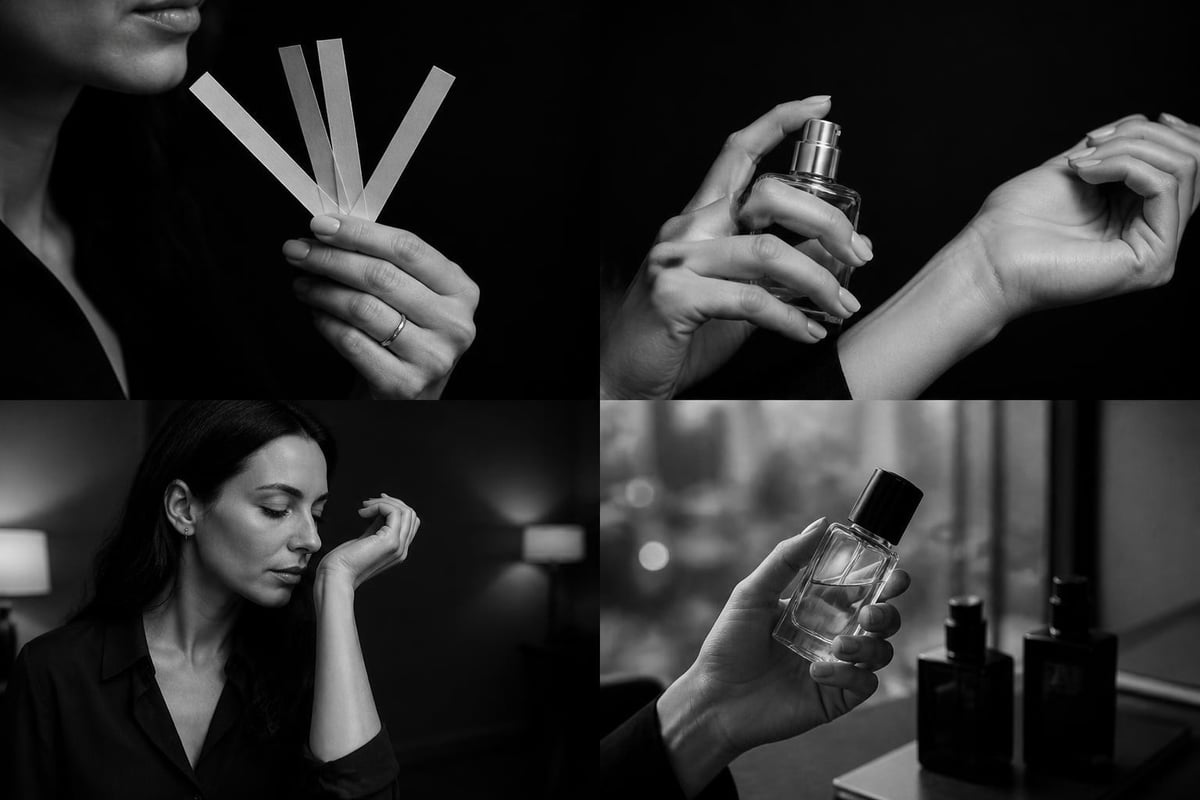
Paper testing strips, called blotters or mouillettes, show you the initial character of a fragrance but never reveal how it will perform on your body. Your skin chemistry, pH level, natural oils, and even diet affect how a perfume develops and lasts. A scent that smells bright and clean on paper might turn sour or flat on your particular skin.
Always test serious candidates on your wrist or inner elbow. Apply the fragrance and wait at least four to six hours before making a judgment. The evolution from top notes through heart notes to base notes takes time, and many perfumes reveal their true character only after several hours of wear.
| Testing Method | Shows You | Limitations | Best Use |
|---|---|---|---|
| Blotter/Paper | Initial impression, top notes, general category | No skin chemistry interaction, no longevity test | First-round elimination of obvious dislikes |
| Wrist/Skin Test | Full development, personal chemistry, actual longevity | Requires hours to assess, can only test 2-3 at once | Final candidates before purchase |
| Sample Vial at Home | Multiple wears, different contexts, seasonal variation | Small investment required | Last step before committing to full bottle |
Why Should You Test Fragrances Over Multiple Days?
A single test tells you whether you dislike a fragrance, but it takes multiple exposures to know if you truly love it. Your perception of scent changes with context, mood, weather, and even what you've eaten recently. A perfume that feels perfect on a cool October morning might overwhelm you on a humid afternoon.
Plan to wear a candidate signature scent at least five to seven times before making a final decision. Notice how it performs in different situations: at work, during exercise, in social settings, and in quiet moments alone. Pay attention to whether you still enjoy smelling it on yourself after eight hours, and whether you receive positive or neutral reactions from others.
How Long Should You Wait Between Testing Different Scents?
Your olfactory system experiences fatigue when exposed to too many fragrances in quick succession. If you test more than three or four perfumes in a single day, you lose the ability to distinguish subtle differences. The best practice involves testing no more than two fragrances on your skin at once, one on each wrist.
Wait at least 24 hours between serious testing sessions. This gives your nose time to reset and allows you to approach each new candidate with fresh perception. Keep notes on your reactions to each fragrance, including time of day, weather conditions, and specific aspects you noticed as it developed.
What Role Does Concentration Play in Finding Your Signature?
Fragrance concentration determines both longevity and projection, which directly affects whether a scent functions well as your signature. IFRA standards and terminology classify perfumes by their concentration of aromatic compounds, typically ranging from eau de cologne (2-4%) through eau de toilette (5-15%) and eau de parfum (15-20%) to pure perfume or parfum (20-30%).
For a signature scent, concentration choice depends on your lifestyle and how you want others to experience your fragrance. Higher concentrations last longer and require less frequent application, but they also sit closer to the skin, creating a more intimate scent experience. Lower concentrations project farther but fade more quickly.
- Parfum/Extrait: Highest concentration, longest lasting, most expensive per volume, intimate projection
- Eau de Parfum: Balanced concentration, good longevity, moderate projection, most popular choice
- Eau de Toilette: Lighter concentration, shorter wear time, stronger initial projection, often fresher compositions
- Eau de Cologne: Lowest concentration, requires frequent reapplication, lightest projection, typically citrus-forward
Oil-based botanical perfumes follow a different paradigm entirely. Without alcohol as a carrier, these formulations sit close to the skin and develop more slowly, creating a deeply personal scent signature rather than one that announces itself across a room. For those exploring botanical perfume alternatives, concentration matters less than the quality and purity of the plant and resin extracts themselves.
How Do You Navigate the Process of Testing in Person?
When you test fragrances at a physical boutique, approach the experience systematically rather than impulsively. Arrive with a clear sense of which fragrance families interest you, based on prior research. Ask the staff to show you examples from your preferred categories rather than sampling randomly from every available option.
In Manhattan neighborhoods like NoMad, smaller boutiques often provide a more personalized testing experience than department store fragrance counters. The staff at specialty shops typically have deeper knowledge of their specific inventory and can guide you toward options that match your stated preferences. They're also more likely to offer samples for home testing rather than pressuring you toward an immediate purchase.
What Questions Should You Ask When Sampling Fragrances?
Start by asking about the fragrance family and composition structure. Understanding whether a perfume is built around floral, resinous, or green botanical elements helps you categorize your reaction and build a vocabulary for your preferences. Ask about the intended wear context: Was this designed for daily wear or special occasions? For warm or cool weather?
Inquire about longevity and projection characteristics. Some perfumes are formulated to last twelve hours with strong projection, while others are designed as skin scents that only the wearer and those very close can detect. Neither approach is superior, but one might align better with your lifestyle and how you want to experience fragrance throughout your day.
What Are the Benefits of Choosing a Botanical Signature Scent?
Botanical perfumes offer distinct advantages for those seeking a signature scent that feels both personal and principled. Formulations built entirely from plant and resin extracts avoid the synthetic musks and aldehydes common in conventional perfumery. This creates fragrances that smell less like commercial products and more like natural environments and materials.
The absence of alcohol in oil-based botanical perfumes changes the wearing experience fundamentally. Instead of an initial burst that fades to a base, botanical oils develop gradually and last differently on each person's skin. This variability makes botanical signatures even more personal, as the same perfume genuinely smells different on different people based on their unique chemistry.
For those learning how to find a signature perfume that aligns with values around ingredients and production, botanical options provide transparency that conventional perfumes rarely offer. When a perfume lists actual plant materials rather than proprietary "fragrance" on its ingredient list, you know exactly what you're wearing.
How Do You Test Whether a Scent Works as Your Long-Term Signature?
Purchase a small bottle or decant before committing to a full-size presentation. Wear the fragrance exclusively for two to three weeks, applying it as you would naturally use a signature scent. This extended test period reveals whether the perfume remains interesting or becomes boring, whether you genuinely enjoy smelling it on yourself repeatedly, and whether it functions well across different contexts in your life.
During this trial period, pay attention to practical considerations beyond pure enjoyment. Does the fragrance last through your workday, or does it require midday reapplication? Do you receive comments about it, and are those comments positive or do they suggest it might be too strong? Does it perform differently in different seasons or climates?
When Should You Abandon a Candidate and Start Over?
If you find yourself hesitating to apply the fragrance or choosing to skip it on certain days, it's not the right signature scent. Your true signature should feel like an enhancement rather than a decision. Similarly, if you catch yourself thinking about other fragrances while wearing your candidate, or if the scent starts to irritate you after the first week, move on to testing something new.
Trust your instincts about olfactory fatigue. Some fragrances are beautiful but lack the complexity to remain interesting with daily wear. Others might be too complex, revealing new facets that you don't enjoy after the initial attraction fades. Neither of these responses indicates a bad perfume, just one that isn't right as your signature.
Should You Choose One Signature or Maintain a Small Rotation?
The traditional concept of a signature perfume implies exclusivity, but many people find that a small rotation of two to three scents serves them better. This approach allows you to maintain olfactory interest while still creating recognizable scent associations. You might alternate between a primary signature worn 70% of the time and one or two secondary options for specific contexts.
If you choose to rotate, select fragrances that share some common characteristics so they feel coherent as a group. Three unrelated scents worn randomly don't create a signature; they simply indicate varied taste. But three fragrances from the same family, or built around similar botanical elements, can function as variations on a theme that others still recognize as distinctly yours.
What Common Mistakes Should You Avoid When Searching?
The most frequent error involves purchasing based on top notes alone. Those first fifteen minutes after application showcase the most volatile components, which are specifically designed to attract attention and encourage purchase. The heart and base notes that emerge later and last longer determine whether you'll actually enjoy wearing the perfume repeatedly.
Another common mistake involves choosing fragrances that smell impressive on others rather than exploring what actually works on your own skin. What smells sophisticated on your friend might turn cloying on you due to chemistry differences. Similarly, avoid purchasing based purely on brand prestige or packaging aesthetics. The liquid inside must work with your body and preferences, regardless of how beautiful the bottle might be.
- Rushing the decision: Signature scents require time to evaluate properly
- Testing too many at once: Olfactory fatigue prevents accurate assessment
- Ignoring seasonal variation: Fragrances perform differently in heat versus cold
- Overlooking concentration options: Same scent in different concentrations can feel entirely different
- Following trends over preference: Your signature should reflect your taste, not current fashion
For those interested in a truly personalized approach, building your own botanical perfume removes guesswork entirely. Selecting from botanical scent profiles to create a custom formulation ensures your signature is literally unique to you.
How Does Skin Chemistry Affect Your Final Choice?
Your skin's pH level, moisture content, and natural oils all interact with perfume molecules to alter how a fragrance develops and lasts. Drier skin absorbs fragrance more quickly, shortening wear time but sometimes intensifying the scent during its active period. Oilier skin holds fragrance longer and can amplify certain notes while suppressing others.
Even factors like medication, diet, and hormonal cycles affect how perfume smells on your skin. This is why the same perfume can smell noticeably different on you from one week to the next. When evaluating candidates for your signature, test them during different points in your monthly cycle if applicable, and note any variations in how they perform.
Can You Change Your Signature Scent Over Time?
Your signature perfume can and likely will evolve as your preferences mature and your life circumstances change. A scent that felt perfect in your twenties might no longer align with who you are in your forties. Seasonal signatures make sense for some people, while others prefer to find a new signature every few years as their tastes develop.
The key distinction involves intentional evolution versus restless hopping between fragrances. Changing your signature after two or three years of consistent wear reflects genuine growth. Changing it every few months suggests you haven't yet found the right fit. Give each serious candidate enough time to prove itself before moving on.
Where Should You Purchase Your Signature Perfume?
Choose retailers that offer samples, return policies, or personalized consultations rather than those that pressure immediate full-bottle purchases. Specialty boutiques typically provide better expertise and customer service than mass-market retailers. The extra cost per milliliter often proves worthwhile when you receive genuine guidance toward fragrances that suit your actual preferences.
Online purchasing offers convenience but removes the ability to test before buying. If you purchase online, seek out retailers that include sample vials with orders or offer discovery sets that let you test multiple options at home. Expert guidance from publications and industry professionals emphasizes the importance of testing on skin before committing to a full bottle.
What Does It Mean When a Perfume Doesn't Suit You?
When people ask how to know if a perfume will suit them, they're often concerned about making an expensive mistake. A perfume doesn't suit you if it triggers headaches, smells unpleasant after the top notes fade, or makes you self-conscious rather than confident. These reactions are immediate disqualifiers, regardless of how beautiful the fragrance might smell in the bottle or on others.
More subtly, a perfume doesn't suit you if it feels like a costume rather than an extension of yourself. Your signature should feel natural and unconsidered, not like you're trying to project an image that doesn't align with your actual personality. This is why how to find a signature perfume ultimately comes down to self-knowledge as much as fragrance knowledge.
How Do Natural Ingredients Impact Your Signature Choice?
Perfumes built from botanical ingredients behave differently than those constructed primarily from synthetic molecules. Natural materials contain hundreds of chemical compounds rather than the single isolated molecules common in synthetic perfumery. This complexity creates fragrances that develop more slowly and sit closer to the skin, but also smell less uniform across different wearers.
Understanding the ingredients and materials in your signature perfume allows you to make informed choices about what you apply to your skin daily. For those with sensitivities to synthetic musks or concerns about ingredient transparency, botanical signatures offer a clear alternative with traceable sourcing.
The vegan and alcohol-free formulations increasingly available in 2026 expand options for those whose values influence their fragrance choices. A signature scent that aligns with your principles around ingredients, production, and sustainability creates congruence between how you smell and how you live.
Frequently Asked Questions
How long does it take to find a signature perfume?
Finding a signature perfume typically requires three to six months of intentional exploration and testing. This timeline includes researching fragrance families, sampling multiple candidates, testing finalists on your skin over several wears, and living with your top choice for at least two weeks before committing. Rushing this process usually results in purchases you later regret or abandon.
Can you wear different perfumes and still have a signature scent?
Yes, you can maintain a signature perfume while occasionally wearing other fragrances for variety or specific occasions. Your signature should be your default choice, worn at least 70-80% of the time, while other perfumes remain occasional alternatives. This approach prevents olfactory boredom while still creating the consistent scent association that defines a true signature.
Do signature perfumes need to be expensive?
Price doesn't determine whether a perfume functions well as your signature. What matters is quality, longevity, how it performs on your particular skin, and whether you genuinely enjoy wearing it repeatedly. Some affordable fragrances last longer and smell better on certain people than luxury alternatives. Focus on finding the right match rather than the highest price tag.
Should your signature perfume match your personality?
Your signature perfume should feel congruent with your authentic self rather than projecting an aspirational or false image. The scent you choose naturally reflects aspects of your personality, preferences, and values. If a fragrance feels like a costume or makes you self-conscious, it won't function well as your signature regardless of how objectively beautiful it might smell.
How do you know when you've found the right signature scent?
You've found the right signature when wearing it feels effortless and natural, when you look forward to applying it, when it lasts comfortably through your day, and when you receive positive feedback that feels authentic rather than overwhelming. The right signature perfume should make you feel more like yourself, not like you're trying to be someone else.
Can botanical perfumes work as signature scents?
Botanical perfumes work exceptionally well as signatures because their natural complexity creates unique interactions with each person's skin chemistry. Oil-based formulations without alcohol develop more slowly and last differently than conventional perfumes, creating truly personal scent signatures. Their ingredient transparency and alignment with natural values make them particularly suitable for those seeking signatures that reflect both aesthetic and ethical preferences.
Finding how to find a signature perfume requires patience, systematic testing, and honest self-assessment about what genuinely suits your skin, lifestyle, and identity. The right fragrance becomes an invisible but powerful element of how you present yourself and how others remember you. If you're drawn to botanical compositions that prioritize natural ingredients and personal scent signatures, explore the handmade perfumes at Haus of Smell, crafted in Manhattan from 100% plant and resin extracts without synthetics or alcohol. Their vegan, oil-based formulations create intimate signatures that develop uniquely on each wearer's skin.