
Eau de parfum (EDP) contains 15-20% fragrance oil in an alcohol base, while parfum (also called extrait de parfum) contains 20-40% fragrance oil, making parfum the most concentrated and longest-lasting commercial fragrance category. The higher oil content in parfum delivers 8-12 hours of wear compared to EDP's 4-6 hours, with parfum requiring less application but commanding higher prices due to the concentration of raw materials.
The debate between edp vs perfume centers on concentration, longevity, and value. Understanding these differences helps you select formulations that match your lifestyle, budget, and scent preferences. The fragrance industry uses specific concentration bands to classify products, and these categories affect everything from how you apply scent to how long it lingers on skin.
What Is the Difference Between EDP and Perfume?
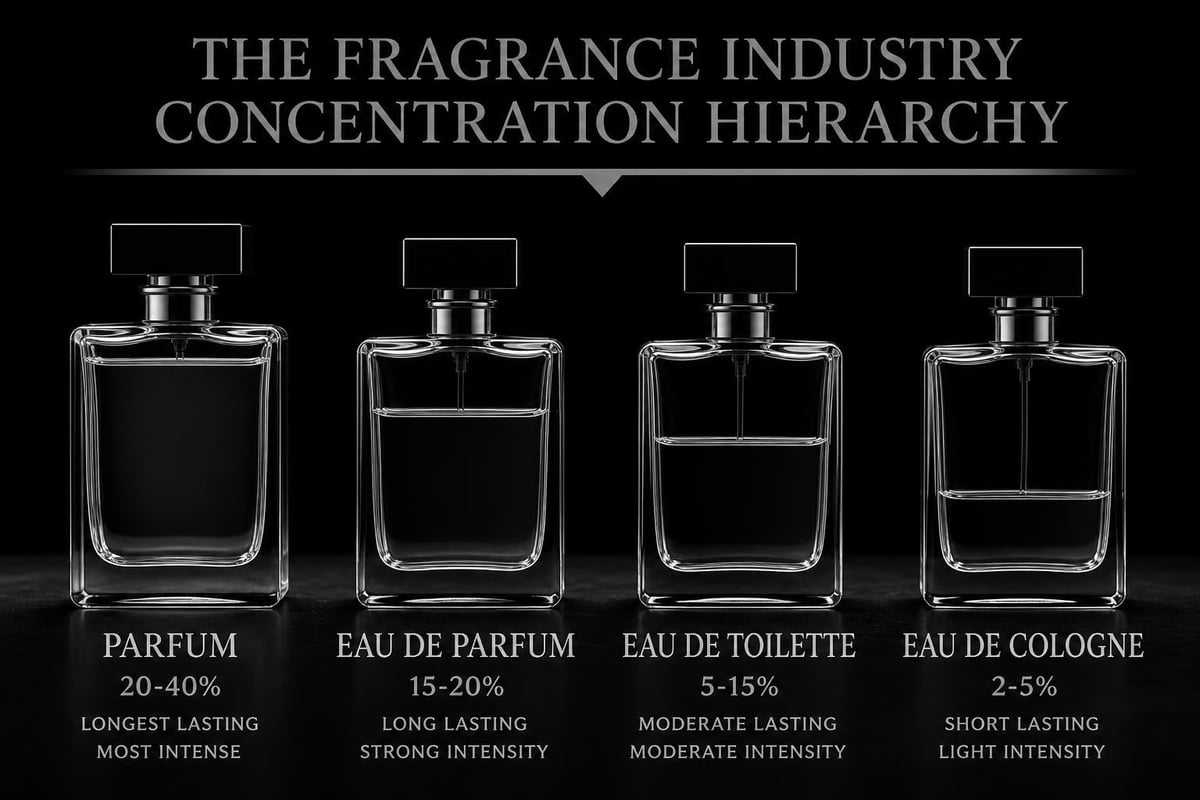
Eau de parfum contains 15-20% fragrance concentrate diluted in alcohol, while parfum (pure perfume or extrait) contains 20-40% concentrate, making it approximately twice as strong. This concentration difference affects projection, longevity, and the way fragrances develop on skin throughout the day.
The IFRA fragrance concentration standards provide industry guidance on these ranges. Parfum sits at the top of the concentration pyramid, followed by eau de parfum, eau de toilette, and eau de cologne. Each step down the pyramid roughly halves the fragrance oil content.
Chemical Composition and Formulation
Both formats use the same core components: fragrance oils (natural or synthetic aromatics), alcohol (typically ethanol), and water. The ratio determines the classification. Parfum uses minimal water and maximum oil, creating a dense, rich formula that feels slightly heavier on skin.
EDP balances concentration with wearability. The lower oil content means faster evaporation of top notes but also lighter initial projection. Research on perfume chemistry shows how concentration affects the release of volatile compounds and the perception of intensity over time.
Botanical formulations take a different approach. Perfume oils skip alcohol entirely, using carrier oils to dilute pure plant extracts, creating a concentration profile that behaves differently than alcohol-based products.
How Long Does EDP Last Compared to Perfume?
Parfum typically lasts 8-12 hours on skin, while eau de parfum lasts 4-6 hours under similar conditions. Longevity depends on concentration, skin chemistry, application method, and environmental factors like humidity and temperature.
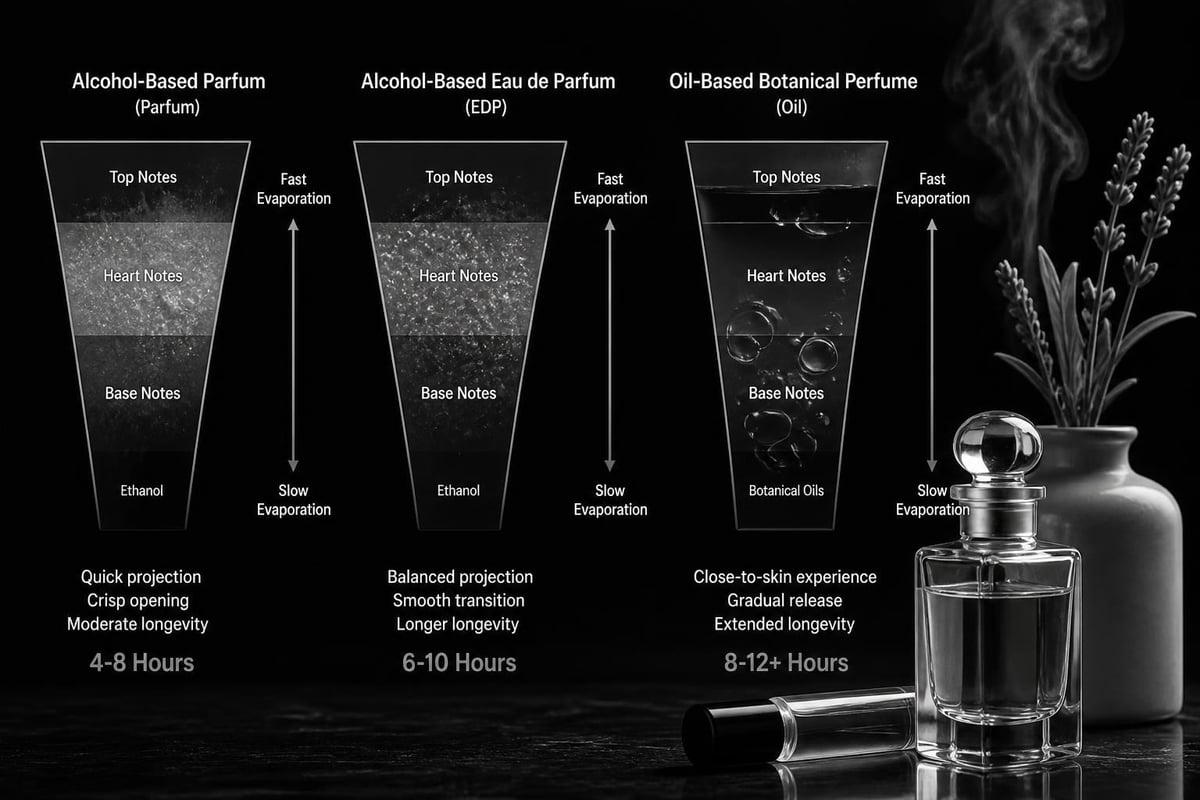
The higher oil content in parfum creates a slower evaporation curve. Alcohol evaporates quickly, carrying volatile top notes into the air. With more oil and less alcohol, parfum releases fragrance compounds gradually, extending wear time. Scientific analysis of on-skin fragrance persistence demonstrates measurable differences in compound release rates across concentration levels.
| Concentration Type | Oil Content | Typical Longevity | Reapplication Needed |
|---|---|---|---|
| Parfum/Extrait | 20-40% | 8-12 hours | Once daily |
| Eau de Parfum | 15-20% | 4-6 hours | Mid-day refresh |
| Eau de Toilette | 5-15% | 2-4 hours | Multiple times |
| Eau de Cologne | 2-5% | 1-2 hours | Every few hours |
Variables That Affect Longevity
Skin type plays a significant role. Oily skin holds fragrance longer than dry skin because oils trap and slow the release of aromatic molecules. Moisturized skin performs better than dehydrated skin for the same reason.
Application site matters. Pulse points (wrists, neck, behind ears) generate warmth that amplifies scent but also accelerates evaporation. Clothing holds fragrance longer than skin but can stain with oil-based formulas.
Climate and season influence wear time. Hot, humid conditions intensify projection but shorten longevity as heat speeds evaporation. Cold, dry weather mutes scent but extends wear because molecular movement slows.
Which Costs More: EDP or Parfum?
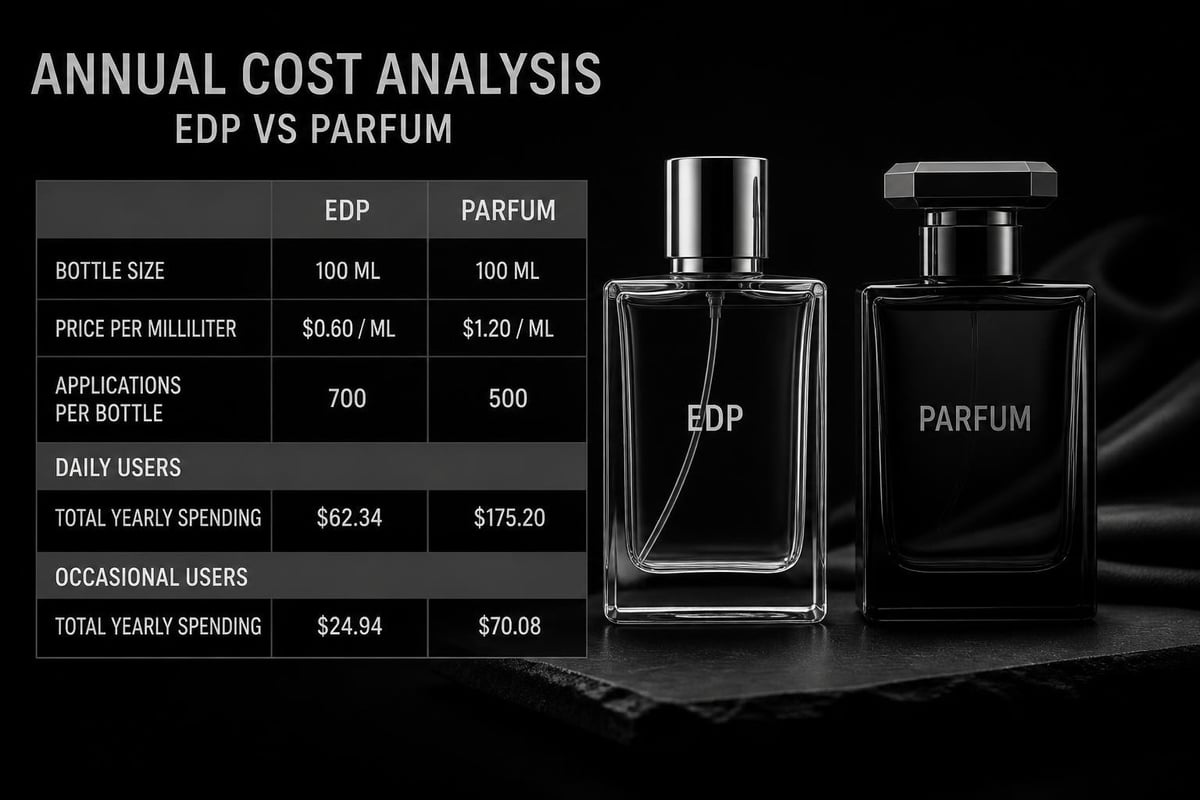
Parfum costs 30-50% more than eau de parfum from the same brand due to higher concentrations of expensive raw materials and smaller production volumes. A 30ml bottle of parfum often costs the same as 50-100ml of EDP, reflecting the material density and luxury positioning.
Production economics explain the price gap. Fragrance oils represent the most expensive component in any formula. Doubling the oil content doesn't just double the cost-it can triple or quadruple it when rare naturals or complex accords are involved.
Parfum bottles also tend to be smaller. A 15ml or 30ml parfum goes further than the same volume of EDP because you need less per application. The cost per wearing may actually favor parfum for special occasions, while EDP offers better value for daily use.
Value Calculation: Cost Per Wear
Daily wearers benefit from EDP economics. A 50ml bottle at $120 providing 500 sprays costs $0.24 per application. If you spray twice daily, that's $0.48 per day or $175 annually.
Parfum users apply less frequently. A 30ml bottle at $180 providing 300 dabs costs $0.60 per application. Used once daily, that's $219 annually-only 25% more than EDP despite the higher unit price, because you use half as much.
When Should You Wear EDP Versus Perfume?
Wear eau de parfum for daytime, office environments, and situations requiring moderate projection with flexibility to reapply. Choose parfum for evenings, special events, and intimate settings where longevity matters more than broad projection.
EDP works well in professional contexts. The moderate sillage won't overwhelm colleagues in close quarters, and the 4-6 hour window aligns with a standard workday. You maintain control over intensity without risking fragrance fatigue in shared spaces.
Parfum excels when reapplication isn't practical. Formal dinners, theater performances, long flights, and outdoor events benefit from set-it-and-forget-it longevity. The richer concentration also performs better in cold weather when lighter formulations disappear quickly.
Application Techniques for Each Concentration
EDP responds well to spray application. Target pulse points with 2-3 sprays, allowing the alcohol to disperse fragrance in a light cloud. The spray mechanism ensures even distribution and controlled dosing.
- Spray EDP from 6-8 inches away to avoid oversaturation
- Focus on wrists, neck, and collarbone for balanced projection
- Layer with unscented moisturizer to extend wear time
Parfum works best with dabbing. The dense, oily texture doesn't atomize well in spray bottles. Apply small amounts with fingertips or a glass applicator to pulse points, warming the fragrance between fingers before pressing onto skin.
- Use one small dab per pulse point-less is more
- Allow 10-15 minutes for the scent to bloom on skin
- Avoid rubbing wrists together, which crushes molecules
Does Skin Type Change How EDP and Perfume Perform?
Skin chemistry significantly affects both formulations, but parfum's higher oil content makes it less dependent on skin moisture. Dry skin absorbs and burns through alcohol-based EDP quickly, while oily skin extends longevity for both types by providing a lipid-rich environment that slows evaporation.
The pH of your skin also influences how fragrances smell. Slightly acidic skin (pH 4.5-5.5) can sharpen bright notes, while more alkaline skin may soften them. Dermatological research on fragrances explores how individual variation creates unique interactions between skin and scent.
Optimizing Performance for Your Skin
Dry skin benefits from preparation. Apply unscented body oil or petroleum jelly to pulse points before fragrance. This creates a barrier that holds aromatic molecules longer, effectively converting your EDP into a pseudo-parfum in terms of longevity.
Oily skin may find parfum overwhelming. The natural oils compound with fragrance oils, creating intense projection that can feel heavy. EDP provides sufficient longevity without the extra richness, making it a better match for oil-prone complexions.
Sensitive skin often tolerates parfum better than EDP. Lower alcohol content reduces irritation and dryness. However, the concentrated oils may trigger reactions in individuals sensitive to specific fragrance components, making botanical formulations a worthwhile alternative.
Are Botanical Perfumes Different From EDP and Parfum?
Botanical perfumes skip synthetic ingredients and alcohol entirely, using plant oils, resins, and carrier oils instead of ethanol bases. This creates an oil-based concentration similar to parfum (15-30% aromatics in carrier oil) but with completely different performance characteristics centered on skin compatibility and scent evolution.
Traditional edp vs perfume comparisons assume alcohol-based formulations. Botanical alternatives like those from Haus of Smell challenge that framework. Without alcohol, there's no quick evaporation phase. The scent develops slowly, staying close to skin rather than projecting outward, and lasting 6-10 hours through oil absorption.
The sensory experience differs markedly. Alcohol-based fragrances hit hard with top notes, then settle into heart and base. Oil-based botanicals release all layers simultaneously at lower volume, creating an intimate scent envelope that warms with body heat. You smell them on yourself more than others smell them across the room.
Why Choose Botanical Over Conventional Concentrations
Alcohol irritates some skin types. Botanical oils eliminate that problem entirely while delivering moisture alongside fragrance. The carrier oils (jojoba, fractionated coconut, sweet almond) condition skin, making botanical eau de parfum a skin-care hybrid rather than purely cosmetic.
Natural plant chemistry creates different longevity patterns. Some botanical materials (resins, woods, roots) have inherently long-lasting molecules that perform well even at moderate concentrations. Others (citruses, delicate florals) fade quickly regardless of oil percentage. This makes botanical concentration less predictable than standardized synthetic formulas.
Vegan and sustainability considerations push some consumers toward botanicals. Alcohol production, synthetic aromachemical manufacturing, and animal-derived ingredients (musk, ambergris, civet) raise ethical questions. Pure plant extraction sidesteps these concerns while supporting different agricultural systems.
How Do You Store EDP and Perfume Properly?
Store both eau de parfum and parfum in cool, dark, stable environments away from direct sunlight, heat sources, and humidity fluctuations. Parfum's higher oil content makes it slightly more stable than EDP, but both degrade when exposed to temperature swings, UV light, or oxygen.
Light breaks down fragrance molecules through photochemical reactions. Keep bottles in their original boxes or in closed drawers. Clear glass offers no UV protection-amber or opaque bottles preserve contents better over years.
| Storage Factor | Impact on EDP | Impact on Parfum | Best Practice |
|---|---|---|---|
| Temperature | High sensitivity to heat | Moderate sensitivity | 60-70°F constant |
| Light exposure | Rapid degradation | Slower degradation | Dark storage |
| Humidity | Minimal effect | Minimal effect | Low humidity preferred |
| Air exposure | Accelerates alcohol evaporation | Oxidizes oils over time | Keep caps tight |
Signs Your Fragrance Has Degraded
Color changes indicate oxidation. Clear fragrances turning yellow or amber fragrances darkening suggest chemical breakdown. Smell your fragrance periodically-sour, metallic, or musty notes mean degradation has begun.
Separation occurs more in parfum than EDP. If you see oil floating on top or sediment at the bottom, the emulsion has failed. Gentle shaking may temporarily recombine components, but the damage is irreversible.
Longevity decline serves as another marker. If your parfum suddenly performs like an eau de toilette, the aromatic compounds have likely oxidized or evaporated. Most fragrances last 3-5 years properly stored, with parfum sometimes extending to 7-10 years due to lower alcohol content.
Can You Layer EDP With Perfume?
Layering eau de parfum with parfum from the same fragrance line creates extended longevity and evolving intensity throughout the day. Apply parfum to pulse points first as a base, then spray EDP over clothing or hair for immediate projection that fades into the longer-lasting parfum foundation.
This technique maximizes both formulations. The EDP provides the initial presence and sillage that parfum alone may lack. As the alcohol evaporates and top notes dissipate, the parfum emerges to carry the scent through afternoon and evening.
Cross-layering different fragrances requires careful selection. Choose complementary scent families (woody with spicy, floral with citrus) rather than competing accords. Start with the heavier, longer-lasting parfum as your base, then add lighter EDP accents that won't overwhelm the primary scent.
Building a Layering Strategy
Season and occasion guide layering choices. Summer heat amplifies projection, so you might skip the EDP and wear just parfum. Winter cold mutes scent, making the EDP + parfum combination necessary for perceivable presence.
Botanical oils layer exceptionally well under alcohol-based fragrances. The oil sits on skin while the alcohol-based spray projects outward. As the spray fades, the oil emerges. This creates a seamless 12-hour fragrance experience that shifts character subtly over time.
Test combinations on skin before committing. What smells harmonious on a blotter may clash with your personal chemistry. Allow 30 minutes for full development before judging whether a layered combination works.
What Do Fragrance Industry Standards Say About EDP vs Perfume?
The International Fragrance Association (IFRA) provides guidelines on fragrance concentrations and safe usage levels but doesn't enforce strict definitions of EDP versus parfum. IFRA standards documentation focuses on maximum allowable amounts of specific ingredients rather than overall concentration categories.
Industry convention, not regulation, defines the boundaries. A brand can technically call a 12% concentration "eau de parfum" even though it falls in the traditional eau de toilette range. Marketing and positioning often matter more than strict adherence to historical concentration bands.
Consumer protection laws require accurate ingredient disclosure but rarely regulate concentration claims. This allows flexibility but also creates confusion. Two "eau de parfum" products may contain vastly different oil percentages, making direct comparisons difficult without manufacturer transparency.
Reading Between the Lines on Labels
Look beyond the concentration name. Some brands list actual percentages on packaging or websites. This transparency helps you compare products across brands and understand what you're buying.
Performance descriptions offer clues. If marketing materials emphasize "long-lasting" or "intense," the concentration likely skews higher within its category. Terms like "fresh" or "light" suggest lower concentrations optimized for projection over longevity.
Price per milliliter correlates loosely with concentration. Expensive fragrances use costly materials, but premium pricing also reflects brand positioning, packaging, and distribution costs. A $300 niche EDP may contain better materials than a $150 designer parfum.
FAQ
Is eau de parfum stronger than perfume?
No, parfum (extrait de parfum) is stronger than eau de parfum. Parfum contains 20-40% fragrance oil versus EDP's 15-20%, making it approximately twice as concentrated. This higher concentration delivers greater longevity and requires less product per application, though it costs more per bottle due to the increased raw material content and luxury market positioning.
How many sprays of EDP equal one dab of parfum?
Approximately 2-3 sprays of eau de parfum equal one small dab of parfum in terms of total fragrance oil delivered to skin. However, the application methods create different experiences-EDP sprays project widely and fade faster, while parfum dabs create intimate, long-lasting scent. The alcohol in EDP also changes how the fragrance develops compared to the oil-rich parfum formulation.
Can you make EDP last as long as parfum?
You can extend EDP longevity by moisturizing skin before application, applying to clothing and hair in addition to pulse points, and layering with matching scented body products. However, EDP fundamentally cannot match parfum's 8-12 hour wear because it contains less fragrance oil. These techniques may push EDP from 4-6 hours to 6-8 hours but cannot overcome the concentration difference entirely.
Why do some brands only make EDP and skip parfum?
Many contemporary brands focus exclusively on eau de parfum because it offers the best balance of longevity, projection, and price accessibility for modern consumers. Parfum requires significantly more expensive raw materials, sells in smaller volumes, and demands different packaging and application formats. The mid-range concentration makes EDP versatile for both daily wear and special occasions without parfum's premium cost.
Does parfum smell different than the same fragrance in EDP?
Yes, parfum typically smells richer and more rounded than the EDP version of the same fragrance because the higher oil concentration allows more complex base materials to emerge. The reduced alcohol also changes the opening-parfum blooms more slowly without the sharp alcohol burst. Some perfumers slightly adjust formulas between concentrations to optimize each version, making parfum and EDP iterations distinct interpretations rather than identical scents at different strengths.
Are oil-based perfumes the same as parfum?
No, oil-based botanical perfumes differ from traditional alcohol-based parfum despite similar concentration levels. Oil-based fragrances use carrier oils instead of ethanol, creating closer-to-skin projection and slower, steadier release. Parfum uses alcohol as the primary solvent with fragrance oils suspended in it. Both deliver long wear, but the sensory experience, projection pattern, and skin interaction differ significantly due to the base formulation.
Understanding the edp vs perfume distinction helps you select fragrances that match your wearing habits, budget, and scent preferences. Whether you prioritize the flexibility and value of eau de parfum or the longevity and luxury of parfum, knowing concentration fundamentals ensures smarter purchases. If you prefer completely botanical alternatives that skip alcohol and synthetics altogether, explore handmade options crafted from pure plant extracts right here in Manhattan at Haus of Smell.