
Eau de parfum contains 15-20% fragrance concentrate in an alcohol base, while parfum (also called extrait de parfum) contains 20-30% concentrate. Parfum lasts longer and costs more, but eau de parfum offers better balance between strength, longevity, and price for most wearers. The choice depends on your budget, how long you want the scent to last, and whether you prefer intensity or subtlety.
The question of eau de parfum or parfum represents more than a simple vocabulary choice. It defines how a fragrance will perform on your skin, how much you will pay, and how the scent will evolve throughout your day. Both terms appear on perfume bottles across the world, yet their meanings remain unclear to most shoppers standing in boutiques from Paris to NoMad, Manhattan.
Understanding these concentration categories helps you make informed purchases and set realistic expectations. A parfum will not necessarily smell "better" than an eau de parfum from the same line. It will simply contain more fragrance material in less carrier, creating different performance characteristics that suit different needs and occasions.
What Is the Difference Between Eau de Parfum and Parfum?
The primary difference between eau de parfum and parfum lies in the concentration of fragrance oils within the final product. Parfum contains the highest concentration of aromatic compounds, typically ranging from 20% to 30%, while eau de parfum contains 15% to 20%. This concentration difference affects longevity, sillage (scent trail), price, and how the fragrance develops over time.
According to the NCBI research on perfume composition, these concentrations are measured as the percentage of fragrance compounds dissolved in the carrier, traditionally ethanol. Higher concentrations mean more aromatic material per application, which translates to longer-lasting scent on skin and fabrics.
How Concentration Affects Performance
The performance gap between these two categories becomes apparent within the first hour of wear. Parfum typically lasts 8 to 12 hours on skin, while eau de parfum lasts 6 to 8 hours under similar conditions. Skin type, climate, and application method all influence these estimates.
Key performance differences include:
- Longevity: Parfum adheres longer due to higher oil content
- Sillage: Parfum projects less but stays closer to skin
- Development: Parfum reveals base notes more slowly and richly
- Reapplication: Eau de parfum often requires midday touch-ups
The difference matters most to those who wear fragrance daily and want consistent performance. A parfum applied once in the morning may still be detectable by evening, while an eau de parfum may fade by mid-afternoon.
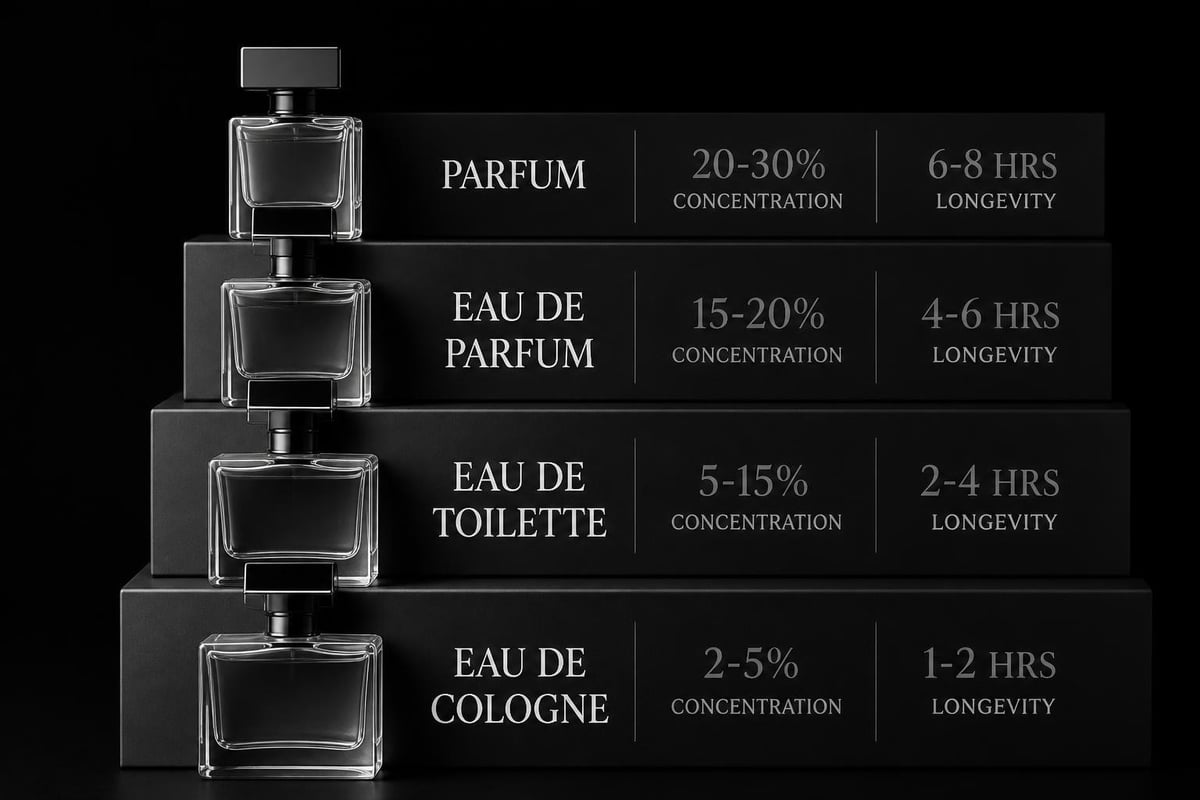
| Concentration Type | Fragrance Oil % | Typical Longevity | Price Range | Best For |
|---|---|---|---|---|
| Parfum (Extrait) | 20-30% | 8-12 hours | $$$-$$$$ | Special occasions, sensitive skin |
| Eau de Parfum | 15-20% | 6-8 hours | $$-$$$ | Daily wear, versatility |
| Eau de Toilette | 5-15% | 3-5 hours | $-$$ | Warm weather, light wear |
| Eau de Cologne | 2-5% | 2-3 hours | $ | Refresh throughout day |
Why Does Parfum Cost More Than Eau de Parfum?
Parfum costs more because it contains a higher concentration of expensive fragrance materials in each bottle. The raw aromatic compounds, especially natural extracts and rare ingredients, represent the most expensive component of any fragrance. When you purchase a parfum, you receive more of these costly materials per milliliter than in an eau de parfum.
Production economics also favor higher pricing for parfum. Manufacturers must use more raw materials to create the same volume of finished product. A 50ml bottle of parfum might contain 10-15ml of pure fragrance concentrate, while the same size eau de parfum might contain only 7.5-10ml.
The packaging often differs as well. Parfum traditionally comes in smaller bottles with more elaborate closures, thicker glass, and premium presentation boxes. These details add cost but reflect the category's positioning as the luxury tier within a fragrance line.
Understanding Price Per Wear
Despite higher upfront costs, parfum may offer better value when calculated by cost per application. Because you need less product per use and reapply less frequently, a 30ml bottle of parfum might last as long as a 50ml bottle of eau de parfum for the same wearer.
Consider these factors when evaluating value:
- Calculate applications per bottle based on your usage pattern
- Estimate how many days each concentration will last
- Factor in seasonal variation (you may use less in winter)
- Account for special occasion vs. daily wear frequency
Which Concentration Should You Choose for Daily Wear?
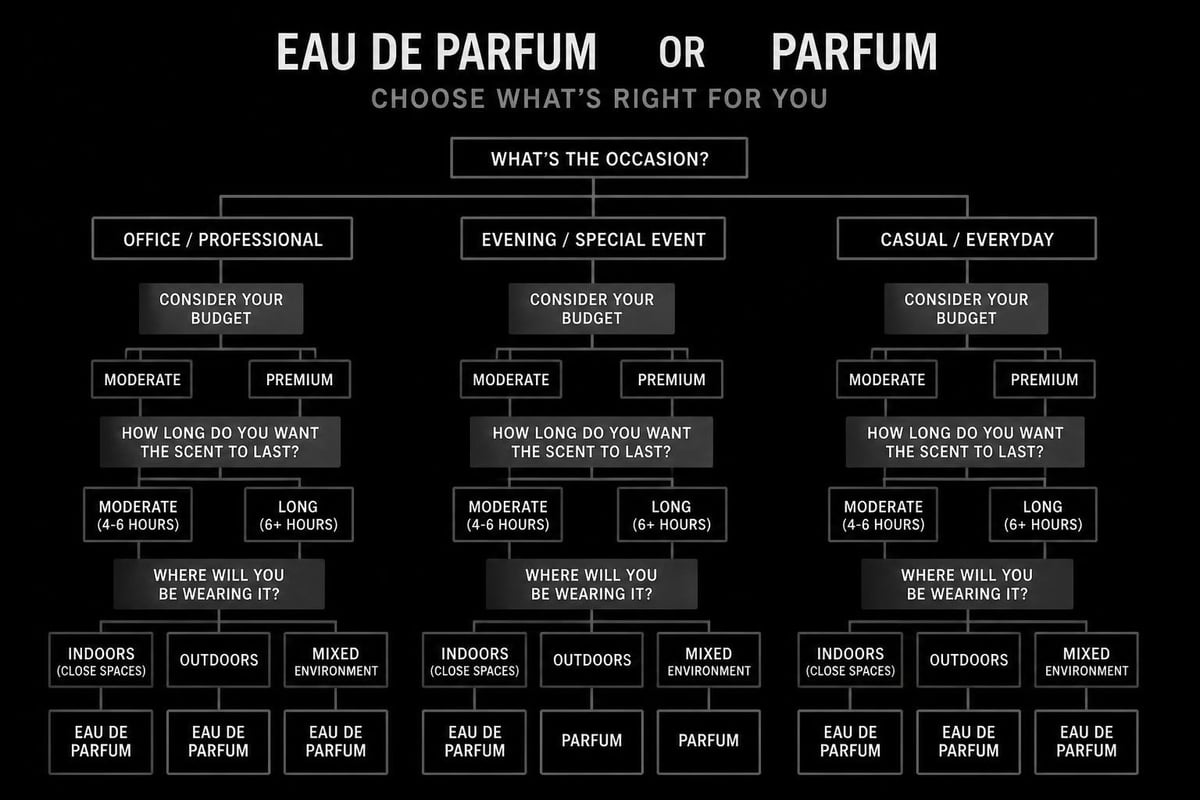
Eau de parfum works best for daily wear because it balances longevity, projection, and price in a way that suits routine use. Most professionals and regular fragrance wearers find eau de parfum strong enough to last through a workday without being overwhelming in close quarters like offices, cafes, or public transportation.
The moderate concentration allows for flexible application. You can apply more on days when you want extra presence or use a lighter hand when you need subtlety. This adaptability makes eau de parfum the most popular concentration category worldwide, accounting for the majority of fine fragrance sales.
Parfum suits special occasions, intimate settings, or situations where you want scent close to your skin without broadcasting it widely. The richness and staying power justify the premium for important events, but the intensity can feel excessive for everyday office wear or casual outings.
Application Strategies for Each Type
For eau de parfum:
- Apply to pulse points (wrists, neck, behind ears)
- One to three sprays typically suffice
- Reapply after 6-8 hours if needed
- Layer with unscented moisturizer for extended wear
For parfum:
- Dab rather than spray for controlled application
- One to two touch points provide adequate coverage
- Focus on warm areas where skin naturally radiates heat
- Rarely requires reapplication within the same day
For those interested in botanical alternatives, Haus of Smell's oil-based botanical perfumes offer a different approach entirely, using plant and resin extracts without alcohol in a carrier that performs similarly to traditional parfum concentrations.
How Do Regulations Affect Parfum and Eau de Parfum?
Fragrance regulations affect both parfum and eau de parfum equally in terms of safety standards, though concentration levels influence how formulators comply with maximum usage limits. The International Fragrance Association (IFRA) Standards establish safe concentration limits for individual ingredients based on the product category, with fine fragrances grouped together regardless of whether they are parfum or eau de parfum.
These standards protect consumers from potential allergens and sensitizing materials. Each fragrance ingredient has a maximum allowed concentration in the final product, measured as a percentage of the total formula. Because parfum contains more total fragrance material, perfumers must ensure concentrated formulas still comply with individual ingredient limits.
Allergen Labeling Requirements
European regulations, particularly EU Regulation 2023/1545 on fragrance allergen labeling, require disclosure of 26 specific fragrance allergens when they exceed certain thresholds. These requirements apply equally to parfum and eau de parfum, though higher concentrations may mean more allergens cross reporting thresholds.
The Research Institute for Fragrance Materials conducts ongoing safety assessments that inform these regulations. Their peer-reviewed research helps establish safe usage levels for both synthetic and natural fragrance materials.
What Are the Historical Origins of These Categories?
The distinction between eau de parfum and parfum originated in 19th-century France, when perfumers standardized concentration categories to help customers understand product strength and price differences. The term "parfum" itself derives from the Latin "per fumum," meaning "through smoke," referencing ancient practices of burning aromatic materials.
According to the Osmothèque perfume conservatory, traditional parfum formulations contained far higher concentrations than modern versions, sometimes reaching 40% or more aromatic material. As commercial perfumery evolved, manufacturers settled on the contemporary ranges we recognize today.
Historical concentration evolution:
- Pre-1900: No standardized categories, custom formulations
- 1900-1950: Parfum dominant, eau de cologne for refreshing
- 1950-1980: Eau de toilette gains popularity for casual wear
- 1980-present: Eau de parfum becomes standard for fine fragrance
The eau de parfum category gained prominence relatively recently, filling the gap between traditional parfum pricing and lighter eau de toilette performance. This middle tier democratized fine fragrance, making sophisticated compositions accessible to broader audiences.
Can You Layer Eau de Parfum and Parfum Together?
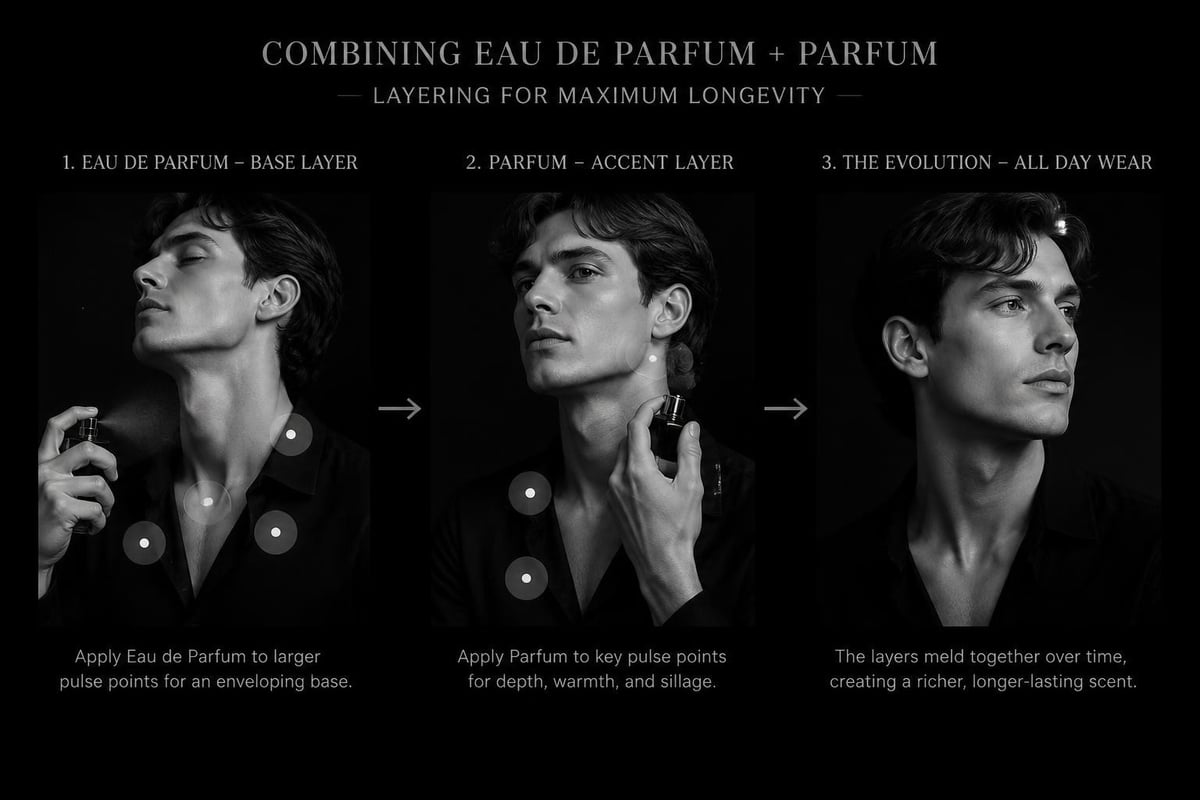
Layering eau de parfum and parfum from the same fragrance line creates a multi-dimensional effect with enhanced longevity and complexity. Apply the eau de parfum more liberally to pulse points for initial projection, then dab parfum concentrate on specific warm areas for depth and staying power. This technique maximizes both the immediate presence and long-term development of the scent.
Many experienced fragrance enthusiasts layer different concentrations strategically. The eau de parfum provides the initial impression and sillage that others notice when you enter a room. The parfum anchor points ensure the scent remains detectable on your skin even after the eau de parfum's top notes have dissipated.
Cross-Concentration Layering Techniques
You can also layer different fragrances at different concentrations for creative combinations. A light eau de parfum might serve as a background while a small touch of unrelated parfum adds an accent. This approach requires restraint to avoid overwhelming combinations.
Successful layering principles:
- Start with lighter concentrations as your base layer
- Use parfum sparingly for accent and depth
- Allow each layer to settle for 30-60 seconds before adding the next
- Test combinations on skin, not paper, for accurate results
Some perfume houses create companion products specifically for layering, like botanical perfume oils that blend seamlessly with traditional alcohol-based fragrances. The oil format provides tenacity while allowing alcohol-based scents to provide projection.
How Does Alcohol Content Differ Between Concentrations?
Alcohol content differs significantly when comparing eau de parfum or parfum, with parfum typically containing 75-80% alcohol while eau de parfum contains 80-85% alcohol. The inverse relationship between fragrance concentrate and alcohol means higher concentration categories need less alcohol as a carrier. This affects drying time, skin feel, and how quickly the scent develops after application.
The type of alcohol matters as much as the percentage. Fine fragrances use denatured ethanol that evaporates quickly and cleanly, carrying volatile top notes into the air while allowing heavier base notes to settle on skin. Different denaturants can affect scent perception in subtle ways.
| Component | Parfum | Eau de Parfum | Eau de Toilette |
|---|---|---|---|
| Fragrance oils | 20-30% | 15-20% | 5-15% |
| Alcohol | 75-80% | 80-85% | 80-90% |
| Water/other | 5-10% | 5-10% | 5-10% |
Alcohol-free formulations, like those created by Haus of Smell using botanical extracts, replace ethanol with carrier oils that perform differently on skin. These oil-based perfumes typically offer concentration levels similar to traditional parfum while providing different projection and longevity characteristics suited to natural materials.
What About Seasonal Considerations for Each Type?
Seasonal temperature and humidity affect how you should choose between eau de parfum or parfum throughout the year. Cold weather slows fragrance evaporation, making parfum ideal for winter when you want long-lasting scent without frequent reapplication. Heat accelerates evaporation, making eau de parfum better suited to summer when lighter, more volatile concentrations feel less overwhelming.
Winter's dry air also means fragrance molecules disperse more slowly, reducing sillage even for higher concentrations. Parfum applied in January will stay closer to your skin than the same formulation worn in July. This seasonal shift allows you to wear richer concentrations in cold months without dominating enclosed spaces.
Summer fragrance strategies:
- Choose eau de parfum over parfum for better heat tolerance
- Apply to clothing rather than skin to slow evaporation
- Focus on fewer application points
- Consider carrying a small decant for midday refresh
Winter fragrance strategies:
- Upgrade to parfum for extended wear in dry conditions
- Apply to skin rather than clothing for better warmth activation
- Layer with unscented body oils to improve projection
- Use more generous application since cold air limits sillage
The humidity level matters as much as temperature. Recent research on olfactory mixture perception suggests that moisture in the air affects how we perceive complex fragrance compositions, meaning the same parfum may smell different in humid summer versus dry winter conditions.
How Do Natural vs. Synthetic Ingredients Affect Concentration Choice?
Natural ingredients behave differently than synthetics at various concentration levels, influencing whether a formula works better as eau de parfum or parfum. Natural extracts from plants, resins, and flowers often contain complex mixtures of hundreds of aromatic molecules, while synthetic ingredients offer single, isolated compounds. This complexity means natural-heavy formulas sometimes perform better at parfum concentrations where their full depth can emerge.
Botanical extracts also tend to be less volatile than many synthetic aroma chemicals, naturally lending themselves to longer-lasting formulations. A parfum built primarily from plant materials may offer extraordinary longevity compared to a synthetic eau de parfum, though projection patterns differ significantly.
Safety considerations shift with natural ingredients as well. Some natural materials contain components that appear on allergen lists or have usage restrictions under IFRA guidance for fragrance standards. Perfumers working with all-natural palettes must carefully balance concentration against regulatory limits.
When exploring botanical eau de parfum formulations, you will notice these plant-based compositions often develop more slowly on skin, revealing their character over hours rather than minutes. This gradual evolution suits the parfum concentration philosophy of long-term wear and close-to-skin intimacy.
Does Skin Chemistry Change How These Concentrations Perform?
Skin chemistry significantly influences how both eau de parfum and parfum develop and last, with factors like pH, oil production, and temperature creating unique results for each wearer. Oily skin tends to hold fragrance longer regardless of concentration, while dry skin may cause even parfum to fade faster than expected. Your individual chemistry can make a parfum perform like an eau de parfum or vice versa.
The pH of your skin affects how fragrance molecules interact with your body's natural oils. Slightly acidic skin (pH 4.5-5.5) tends to preserve fragrance better than alkaline skin, though extreme acidity can distort certain aromatic compounds. Diet, medication, and hormonal cycles all influence skin pH throughout the day and across seasons.
Testing Concentrations on Your Skin
The only reliable way to know how eau de parfum or parfum will perform for you involves testing on your own skin over several hours. Paper blotters and tester strips show how a fragrance smells in isolation, but they cannot predict longevity or development on your specific chemistry.
Proper testing method:
- Apply fragrance to clean, unscented skin
- Wait at least 30 minutes before evaluating
- Check progression at 1 hour, 4 hours, and 8 hours
- Note how heat and activity affect the scent
- Test on different body areas (wrist vs. neck) for variation
Body temperature zones also matter. Warmer areas like the neck and inner wrists activate parfum more effectively, while cooler zones like the backs of hands may not provide enough warmth to fully develop concentrated formulas. Finding your optimal application points requires experimentation with each concentration type.
FAQ
Is parfum always better quality than eau de parfum?
No, parfum concentration does not indicate better quality, only higher fragrance oil percentage in the formula. A well-crafted eau de parfum from a skilled perfumer can surpass a poorly executed parfum in complexity, balance, and overall appeal. Quality depends on ingredient selection, formula design, and craftsmanship rather than concentration alone. Some fragrances work better at eau de parfum strength because their composition benefits from lighter concentration.
How long does each concentration typically last on skin?
Parfum lasts 8 to 12 hours on average skin, while eau de parfum lasts 6 to 8 hours under normal conditions. Individual results vary based on skin type, climate, application method, and the specific formula's composition. Dry skin, hot weather, and rubbing application points reduce longevity for both types. Oily skin, cool temperatures, and dabbing rather than rubbing extend wear time significantly.
Can you make eau de parfum last as long as parfum?
You can extend eau de parfum longevity through proper application techniques, though it rarely matches true parfum duration. Apply to moisturized skin, focus on warm pulse points, spray clothing or hair, and layer with matching unscented products. These methods improve performance but cannot fully overcome concentration differences. Reapplication at the 6-hour mark offers better results than trying to force all-day wear from a single eau de parfum application.
Should beginners start with eau de parfum or parfum?
Beginners should start with eau de parfum because it offers easier application control, lower initial investment, and more versatility across occasions. The moderate concentration forgives application mistakes better than parfum, which can overwhelm when applied too generously. Once you understand your preferences and application technique, exploring parfum versions of favorite scents adds depth to your collection. Eau de parfum provides the foundation for fragrance education.
Do parfum and eau de parfum smell exactly the same?
Parfum and eau de parfum from the same line smell similar but not identical due to concentration-driven differences in how notes balance and develop. Higher concentration in parfum emphasizes base notes and creates richer depth, while eau de parfum often showcases brighter top notes with more immediate impact. Some houses reformulate between concentrations to optimize each version's performance, creating noticeable scent variations. Always test both if precise scent character matters to you.
How should you store parfum differently than eau de parfum?
Store both parfum and eau de parfum in cool, dark locations away from direct sunlight, heat sources, and humidity fluctuations. Parfum's higher oil content makes it slightly more stable than eau de parfum, but both deteriorate when exposed to temperature extremes or UV light. Keep bottles tightly sealed when not in use, avoid bathroom storage due to humidity, and consider refrigeration for long-term storage of valuable bottles. Proper storage extends life for both concentrations equally.
Choosing between eau de parfum or parfum comes down to understanding how concentration affects your daily fragrance experience, from longevity and projection to price and occasion appropriateness. Both categories serve distinct purposes in a well-rounded scent wardrobe, with eau de parfum handling versatile everyday wear and parfum providing special-occasion richness. If you prefer fragrances crafted entirely from botanical ingredients without alcohol or synthetics, explore the handmade collection at Haus of Smell, where every oil-based perfume is created in Manhattan using 100% plant and resin extracts that perform with the staying power of traditional parfum concentrations.