
The difference between EDT and parfum lies primarily in concentration: Eau de Toilette contains 5-15% fragrance oils in an alcohol base, while parfum (also called extrait de parfum) contains 15-40% oils, making it more intense, longer-lasting, and typically more expensive per milliliter.
Understanding fragrance types can transform how you buy, wear, and appreciate scent. The perfume industry uses specific terms to classify products by their strength and duration, yet these categories remain confusing for many consumers. When you walk into a fragrance counter or perfume store in Manhattan, you encounter bottles labeled Eau de Toilette, Eau de Parfum, Parfum, and Cologne without clear explanations of what separates them. The terminology originates from French perfume houses, where concentration levels determined both the price point and the intended use occasion. Today, these distinctions matter for practical reasons: they affect how long a scent lasts on your skin, how it develops throughout the day, and how much you should apply.
What Is the Primary Difference Between EDT and Parfum?
The primary difference between EDT and parfum is concentration level. Eau de Toilette typically contains between 5% and 15% fragrance oils diluted in alcohol, while parfum (extrait de parfum) contains 15% to 40% fragrance oils with minimal alcohol or an oil base. This concentration gap creates measurable differences in intensity, longevity, and price.
The International Fragrance Association provides guidance on industry-typical ranges, though no universally fixed definitions exist across all markets. European and American manufacturers generally follow similar concentration brackets, but individual brands may interpret these ranges differently. A high-quality Eau de Toilette from one house might perform similarly to an Eau de Parfum from another, depending on the raw materials and formulation techniques employed.
How Concentration Affects Performance
Higher concentration means more fragrance molecules on your skin, which translates to stronger initial impact and extended wear time. Parfum formulations release scent gradually over 8-12 hours or longer, while EDT typically lasts 3-6 hours before requiring reapplication. The alcohol content also influences evaporation rate: EDT's higher alcohol percentage causes faster initial diffusion but shorter overall duration.
Concentration impacts sillage (the scent trail you leave) and projection (how far the scent radiates from your body). Parfum creates a more intimate scent experience that stays closer to the skin, while EDT projects further initially but fades faster. This explains why parfum is often applied sparingly to pulse points, while EDT can be sprayed more liberally across the body and clothing.
How Long Does EDT Last Compared to Parfum?
EDT typically lasts 3-6 hours on skin, while parfum lasts 8-12 hours or more. The extended longevity of parfum comes from its higher concentration of fragrance oils and lower alcohol content, which slows evaporation and allows the scent to develop more gradually across its full composition.
Individual skin chemistry significantly affects wear time for both formulations. Oily skin tends to hold fragrance longer than dry skin, regardless of concentration. Environmental factors like temperature, humidity, and air circulation also influence how quickly fragrance molecules dissipate. The Perfume Society explains that these practical differences in longevity make EDT more suitable for office environments or situations where you want a lighter presence, while parfum works well for special occasions or evening wear.
| Factor | Eau de Toilette (EDT) | Parfum |
|---|---|---|
| Duration on skin | 3-6 hours | 8-12+ hours |
| Reapplication needed | Yes, often midday | Rarely, once per day |
| Best for | Daytime, office, casual | Evening, special occasions |
| Skin type impact | Moderate | Lower (lasts on all types) |
The longevity difference justifies the price gap between these two categories. While parfum costs more per bottle, the amount needed per application is smaller, and reapplication is rarely necessary. A single drop of parfum on each pulse point often suffices for all-day wear, whereas EDT may require several sprays and a midday refresh.
Why Is Parfum More Expensive Than EDT?
Parfum costs more than EDT because it contains a higher percentage of fragrance oils, which are the most expensive components in any scent product. The raw materials, particularly natural botanical extracts, represent the primary cost driver in perfumery, and parfum formulations require three to eight times more of these materials than EDT.
Production economics favor EDT for mass-market distribution because alcohol serves as an inexpensive carrier that allows manufacturers to create larger volumes at lower cost. Parfum production, by contrast, requires careful blending of concentrated oils with minimal dilution, demanding more precision and higher-quality base materials. The Research Institute for Fragrance Materials conducts safety assessments that inform how different concentrations are formulated, and higher concentrations require additional testing and quality control measures.
Material Costs and Formulation Complexity
Natural ingredients vary widely in price based on availability, harvest conditions, and extraction methods. A botanical extract that costs $200 per kilogram in EDT formulation might require $600-1,600 worth of material for the same volume of parfum. This cost multiplication applies to every ingredient in the composition, from top notes through base fixatives.
Beyond raw materials, parfum formulations require master perfumers to work with more concentrated bases, where any imbalance becomes immediately apparent. The formulation process takes longer, requires more refinement, and often involves a higher rejection rate during quality testing. These factors contribute to the retail price premium consumers pay for parfum over EDT.
Which Should You Choose: EDT or Parfum?
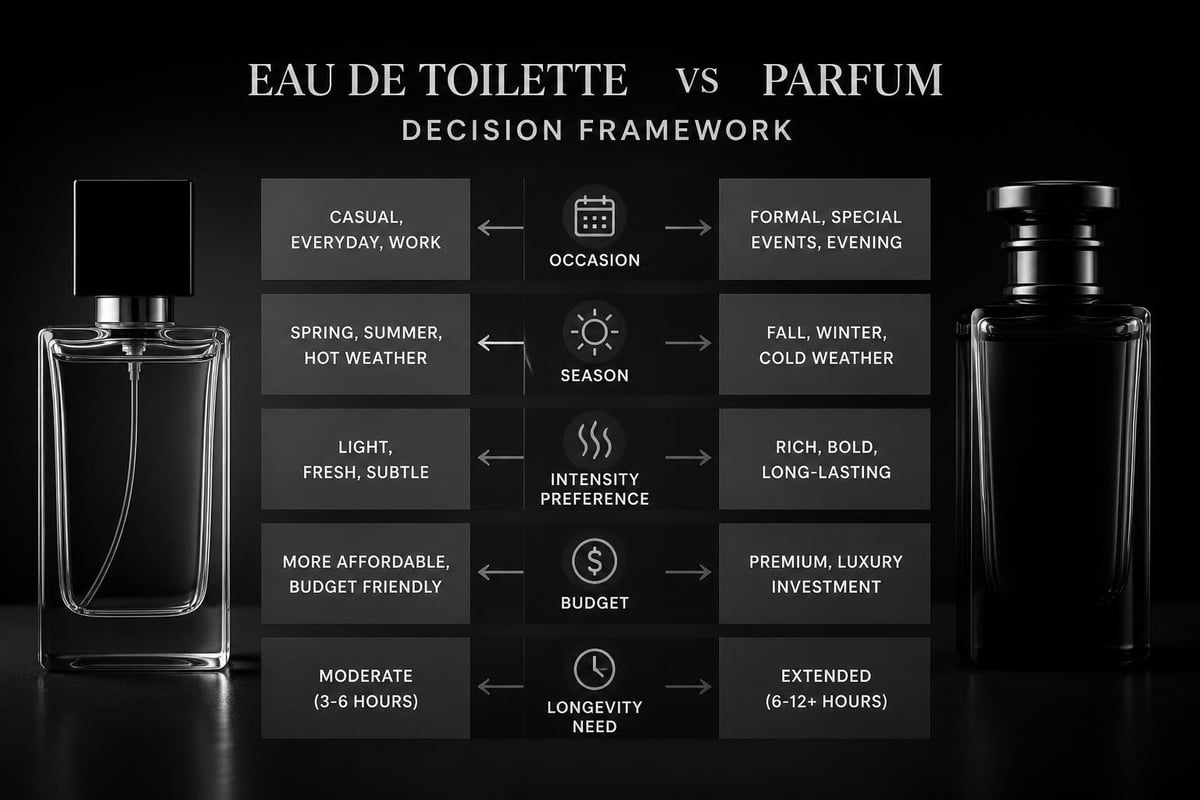
Choose EDT if you prefer lighter, more refreshing scents for daily wear, office environments, or warm weather, and if you enjoy reapplying fragrance throughout the day. Choose parfum if you want maximum longevity, prefer rich and complex scent experiences, or need a fragrance that lasts through long events without reapplication.
Your budget and usage patterns should guide this decision. EDT offers better value if you wear fragrance casually and enjoy variety, since the lower price point allows you to own multiple bottles for different moods and occasions. Parfum makes economic sense if you wear the same signature scent daily, since the higher concentration means one bottle lasts significantly longer despite the higher upfront cost.
- Choose EDT when: You want a fresh, light presence | You work in scent-sensitive environments | You enjoy fragrance layering | Budget allows multiple bottles | Summer and warm climates
- Choose Parfum when: You need all-day performance | You prefer intimate, close-to-skin scents | You have a signature scent | Special occasions and evening wear | Winter and cool climates
How Do Alcohol-Free Formulations Compare?
Alcohol-free formulations, typically oil-based, behave differently from both traditional EDT and parfum because they eliminate the volatile carrier that creates initial projection. Oil-based perfumes sit entirely in the concentration range of parfum (15-40% fragrance oils in a neutral carrier oil), but they wear closer to the skin and develop more slowly throughout the day.
The absence of alcohol changes the scent profile significantly. Alcohol-based fragrances create an immediate burst of top notes as the alcohol evaporates, followed by the heart and base notes. Oil-based formulations reveal their composition more gradually, with less dramatic evolution but more consistent presence. For those with sensitive skin or alcohol sensitivities, oil-based options provide a viable alternative that still delivers the intensity and longevity associated with high-concentration formulations.
Haus of Smell creates botanical Eau de Parfum using oil-based formulations with natural plant and resin extracts, eliminating both alcohol and synthetic materials while maintaining the concentration levels typically associated with parfum. This approach suits those who want lasting fragrance without the drying effects of alcohol or the sharp initial burst that alcohol creates.
Regulatory and Safety Considerations
The European Union Cosmetics Regulation establishes labeling requirements and safety standards for fragrance products across concentration levels. Both EDT and parfum must comply with the same allergen disclosure rules, though the higher concentration in parfum means potential allergens appear in greater amounts per application. The European Commission's guidance on fragrance allergen labeling requires manufacturers to list 26 specific allergens when present above certain thresholds.
Safety assessments consider exposure levels, which vary between EDT and parfum due to concentration differences. The Fragrance Materials Safety Resource provides peer-reviewed research on how different concentrations affect sensitization risk and appropriate usage levels. Well-formulated products in both categories pass rigorous safety testing, but individuals with known sensitivities should patch-test any new fragrance regardless of concentration.
What About Eau de Parfum and Other Categories?
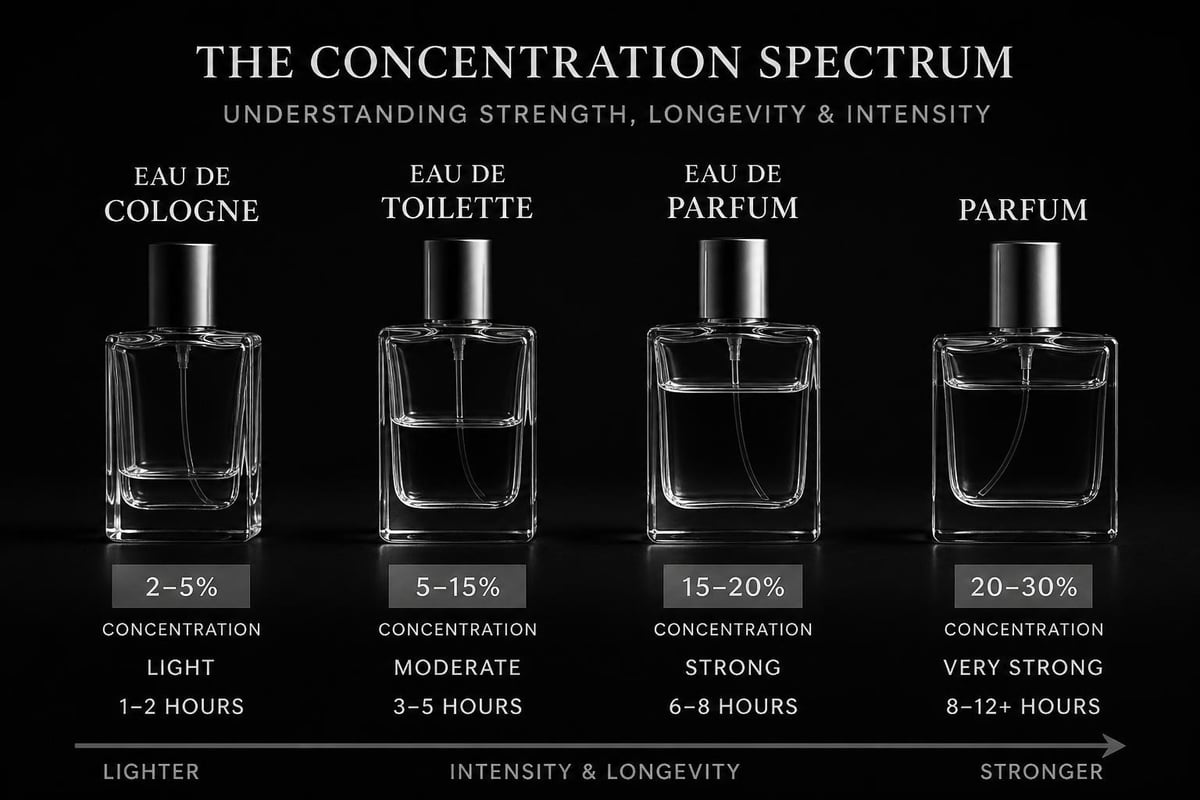
Eau de Parfum (EDP) sits between EDT and parfum, typically containing 15-20% fragrance oils. This middle category has become the most popular concentration in contemporary perfumery because it balances longevity with price accessibility. EDP lasts 6-8 hours, longer than EDT but not as long as pure parfum, and costs less than parfum while providing noticeably better performance than EDT.
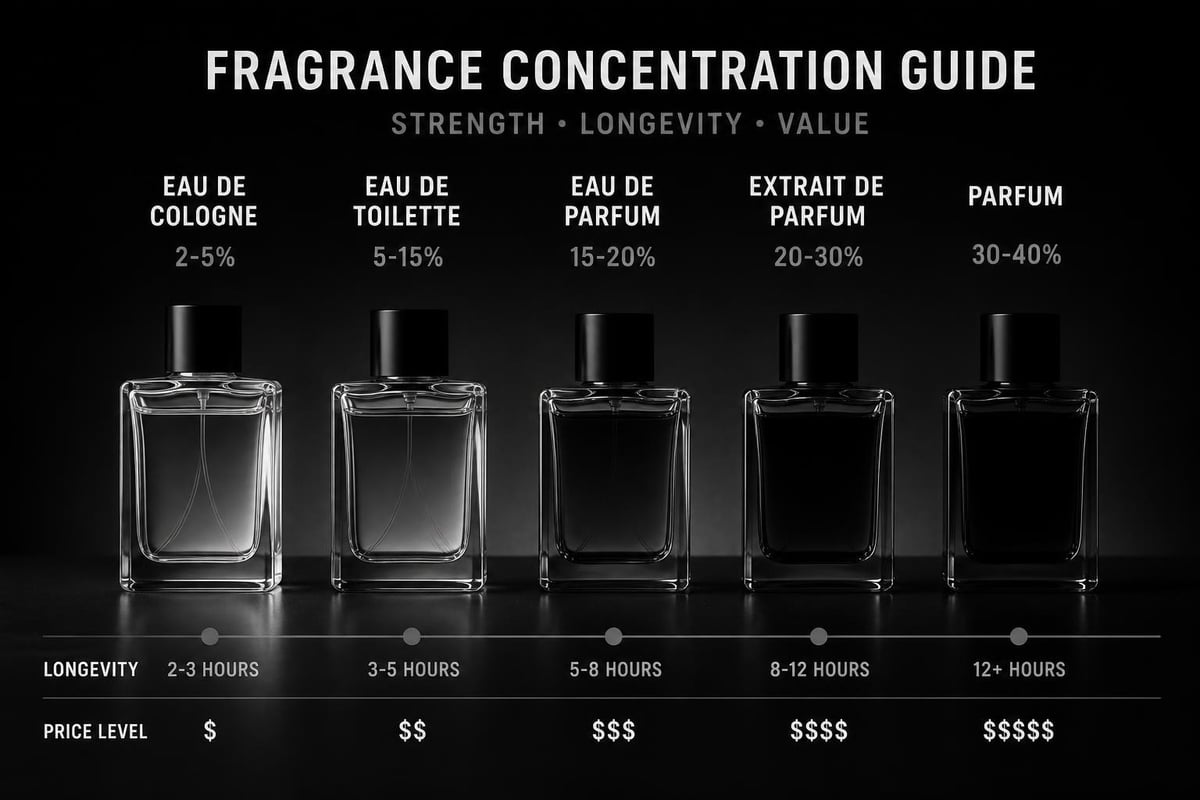
The complete fragrance concentration spectrum includes:
- Eau de Cologne: 2-5% fragrance oils, lasting 1-2 hours, very light and refreshing
- Eau de Toilette: 5-15% fragrance oils, lasting 3-6 hours, suitable for daily wear
- Eau de Parfum: 15-20% fragrance oils, lasting 6-8 hours, popular middle ground
- Parfum/Extrait de Parfum: 15-40% fragrance oils, lasting 8-12+ hours, most concentrated
These ranges overlap because manufacturers interpret categories differently and because the quality of ingredients affects performance independent of concentration. A well-crafted EDT using high-quality materials may outlast a poorly formulated EDP with synthetic extenders.
Historical Development of Fragrance Categories
McGill University's Office for Science & Society traces how these categories evolved from practical needs in perfume manufacturing. Eau de Cologne originated in the 18th century as a light, citrus-based splash for refreshment, while parfum remained the preserve of wealthy customers who could afford concentrated extracts. Eau de Toilette emerged as a middle category in the 19th century, literally meaning "water for washing," intended as a lighter alternative to parfum for daily grooming.
The 20th century saw EDT and EDP become dominant categories as mass production made fragrance accessible to broader markets. Parfum decreased in popularity relative to these categories, though it never disappeared and has seen renewed interest in recent years as consumers seek luxury experiences and signature scents that differentiate them from mass-market offerings.
How Does Botanical Perfumery Handle These Distinctions?
Botanical perfumery applies the same concentration principles as conventional perfumery but faces unique challenges when working exclusively with plant-based materials. Natural extracts behave differently from synthetic aroma chemicals, often requiring higher concentrations to achieve similar intensity and lasting power. Many botanical perfumers work primarily in the EDP and parfum concentration ranges because natural materials perform best at higher loadings.
Natural ingredients also limit certain formulation techniques common in conventional perfumery. Synthetic musks and fixatives, which extend longevity in many commercial fragrances, are unavailable to botanical perfumers committed to 100% natural formulations. Instead, botanical perfumers rely on natural fixatives like plant resins, which work best at higher concentrations. This technical reality explains why many botanical fragrances cluster in the EDP to parfum range rather than offering EDT versions.
The difference between EDT and parfum becomes particularly relevant when discussing scented products made from botanical materials. Natural perfumery often favors oil-based parfum formulations because they preserve the integrity of delicate plant extracts that might degrade or smell harsh in high-alcohol environments. The absence of alcohol also aligns with vegan and skin-sensitive formulation goals common in botanical perfumery.
How Should You Apply EDT Versus Parfum?
Apply EDT with 3-5 sprays to pulse points and clothing, distributing it across a larger area since the lighter concentration requires more coverage. Apply parfum sparingly with 1-2 small dabs to pulse points only, as the higher concentration means a little goes a long way and over-application can become overwhelming.
EDT Application Method:
- Spray once on each wrist
- Spray once on the neck or chest
- Optional: spray once on clothing or hair
- Do not rub wrists together (breaks down the fragrance structure)
- Reapply after 4-6 hours if desired
Parfum Application Method:
- Dab a small amount on one wrist using the stopper or your finger
- Press wrists together gently
- Dab behind ears or on neck
- Allow to dry naturally without rubbing
- No reapplication needed for 8-12+ hours
Pulse points (wrists, neck, behind ears, inner elbows) work best because these areas generate warmth that helps diffuse fragrance molecules. The Osmothèque's technical resources on concentration explain that heat activates fragrance release, which is why pulse points have been traditional application sites for centuries.
Can You Layer EDT and Parfum?
You can layer EDT and parfum, though this practice works best when using the same fragrance in different concentrations rather than mixing different scents. Applying parfum to pulse points first, then misting EDT over clothing and hair, creates a multi-dimensional effect with both immediate projection and lasting depth.
Layering different fragrances requires careful consideration of how their compositions interact. Complementary scents from the same family (florals with florals, woods with woods) layer more successfully than contrasting categories. Some experienced fragrance enthusiasts deliberately layer EDT and parfum versions of different scents to create unique combinations, but this approach requires experimentation and a developed sense of how different notes interact.
For those new to layering, starting with unscented or lightly scented base products (lotions, oils) can extend any fragrance's longevity without adding complexity. Applying a neutral moisturizer to skin before fragrance application creates a hydrated surface that holds scent molecules longer, benefiting both EDT and parfum formulations.
What Do Industry Standards Say About These Categories?
Industry standards acknowledge that fragrance concentration categories lack rigid universal definitions. The IFRA compiled Standards document focuses on safety limits for specific materials rather than defining what constitutes EDT versus parfum. These standards set maximum use levels for potentially sensitizing ingredients, with different limits applying based on product category and leave-on versus rinse-off application.
What the industry calls "parfum" or "fragrance" on ingredient lists refers to the fragrance mixture itself, not the concentration level. This nomenclature confuses consumers who see "parfum" on an EDT bottle's ingredient list and assume they're buying a high-concentration product. The ingredient declaration "parfum" simply means "fragrance mixture," while the product type (EDT, EDP, parfum) determines the concentration.
| Standard/Regulation | Scope | Impact on EDT vs Parfum |
|---|---|---|
| IFRA Standards | Safety limits for ingredients | Same material limits apply; concentration affects total exposure |
| EU Cosmetics Regulation | Product safety and labeling | Both must list allergens; same compliance requirements |
| RIFM Safety Assessment | Ingredient research | Evaluates safe exposure levels relevant to all concentrations |
Professional perfumers and evaluators understand these nuances, but consumer-facing marketing often oversimplifies or ignores them. Reputable brands provide concentration information either on packaging or through customer service, while less transparent sellers may use ambiguous terms that obscure actual fragrance content.
Does Price Always Reflect Quality in Parfum?
Price does not always reflect quality in parfum or EDT. While raw material costs and concentration levels justify price differences between categories, substantial variation exists within each category based on brand positioning, marketing expenses, and distribution costs rather than actual fragrance quality.
A $300 designer parfum may contain similar or even lower-quality ingredients than a $100 niche parfum, with the price premium funding advertising campaigns, celebrity endorsements, and luxury retail placement rather than superior materials or craftsmanship. Conversely, some expensive parfums justify their cost through rare natural ingredients, master perfumer expertise, or small-batch production that demands higher pricing.
Evaluating quality requires looking beyond price to consider:
- Ingredient transparency: Does the brand disclose materials and sourcing?
- Longevity testing: How does the fragrance actually perform on your skin?
- Complexity: Does the scent evolve interestingly or smell flat?
- Brand reputation: What is the maker's track record for quality?
- Reviews from trusted sources: What do knowledgeable users report?
The difference between EDT and parfum becomes meaningful only when both are well-formulated. A poorly made parfum with synthetic extenders and low-quality bases offers worse value than a well-crafted EDT using quality natural materials, regardless of concentration percentages.
Frequently Asked Questions
Does EDT or parfum last longer on clothing?
Both EDT and parfum last longer on clothing than on skin, but parfum still outlasts EDT on fabric. Clothing fibers trap fragrance molecules without absorbing them into skin's oils, creating persistence that can extend for days or even weeks. EDT on clothing typically lasts 8-12 hours, while parfum can remain detectable for 24-48 hours or longer on natural fibers.
Can you make EDT last as long as parfum?
You cannot make EDT last as long as parfum through application techniques alone, because longevity depends primarily on concentration. However, applying EDT to moisturized skin, layering with matching scented products, and spraying on clothing can extend its wear time to 6-8 hours, approaching EDP performance though still falling short of true parfum longevity.
Is parfum better for sensitive skin than EDT?
Parfum is not necessarily better for sensitive skin than EDT. While parfum contains less alcohol (which can dry or irritate skin), it contains more fragrance materials that may cause reactions in sensitive individuals. Alcohol-free oil-based formulations often work best for sensitive skin, regardless of whether they're labeled as EDT or parfum concentration. Patch testing remains essential for anyone with skin sensitivities.
Why do some EDT fragrances cost more than parfum?
Some EDT fragrances cost more than parfum from other brands due to marketing positioning, brand prestige, packaging costs, and retail markup rather than concentration alone. Designer brands with high advertising budgets often charge premium prices for EDT formulations, while niche or independent makers may offer parfum at lower prices due to direct-to-consumer sales models and minimal marketing overhead.
How can you tell if a fragrance is EDT or parfum?
You can tell if a fragrance is EDT or parfum by checking the label, which should state "Eau de Toilette," "Eau de Parfum," or "Parfum/Extrait de Parfum." If the label lacks this information, contact the manufacturer directly. Concentration information may also appear in product descriptions or specifications. Reputable sellers always disclose fragrance type, and absence of this basic information suggests poor transparency.
Do natural perfumes follow the same EDT and parfum categories?
Natural perfumes can follow the same EDT and parfum concentration categories as conventional fragrances, though many natural perfumers work primarily in the EDP to parfum range. Natural materials often require higher concentrations to achieve desired intensity and longevity, and many natural perfumes use oil bases instead of alcohol, which technically places them in the parfum category regardless of how they're marketed.
The difference between EDT and parfum ultimately comes down to concentration, longevity, and intensity, with each serving distinct purposes in a well-rounded fragrance wardrobe. Understanding these distinctions helps you make informed choices that align with your lifestyle, budget, and scent preferences. If you're exploring botanical alternatives crafted without alcohol or synthetics, visit Haus of Smell in Manhattan to experience handmade, vegan perfumes that bring together the lasting power of traditional parfum with 100% natural plant-based formulations.