
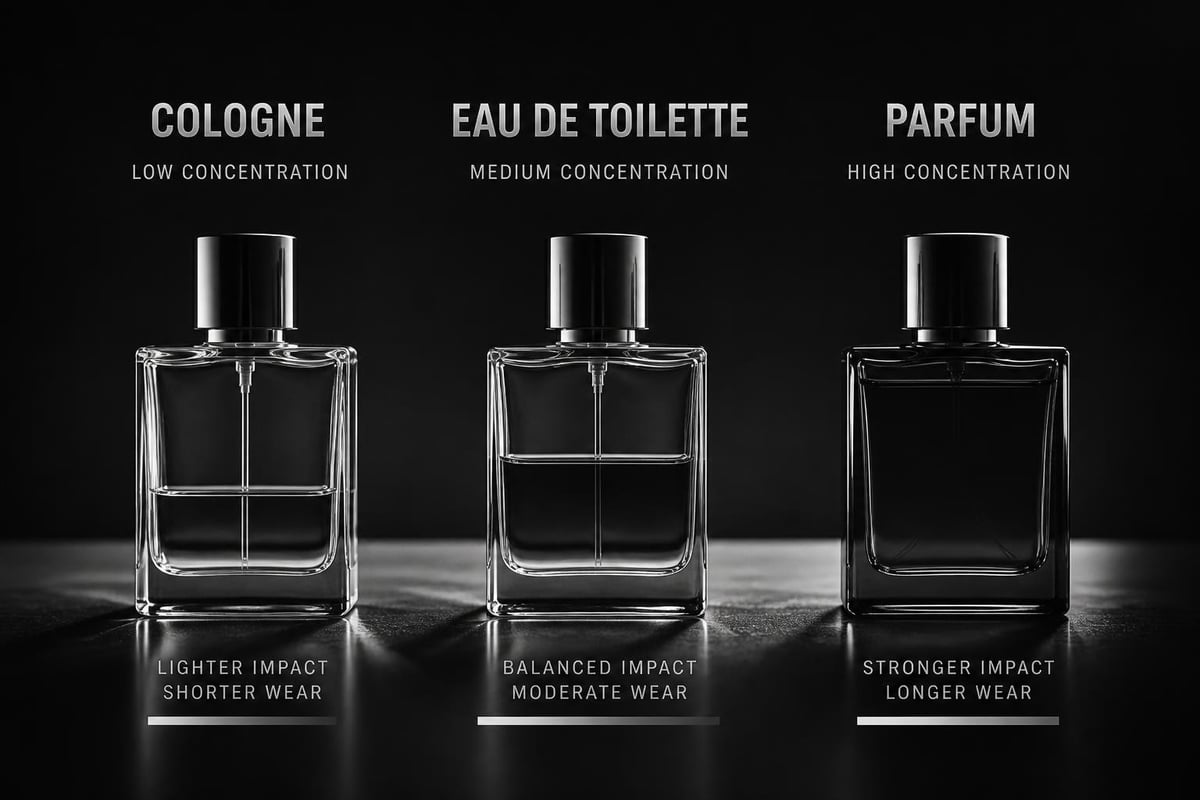
The diff between cologne and perfume is primarily determined by concentration: cologne typically contains 2-5% aromatic compounds in an alcohol base, while perfume (or parfum) contains 20-40% fragrance concentration. This difference in strength affects longevity, intensity, and how each product interacts with skin throughout the day. Beyond chemistry, the two categories carry distinct historical contexts and cultural associations.
Understanding these distinctions helps you select fragrances that align with your needs, whether you prefer a subtle daily presence or a lasting statement. The terminology itself reveals centuries of perfumery tradition, regulatory frameworks, and evolving consumer expectations.
What Is the Main Diff Between Cologne and Perfume?
The primary diff between cologne and perfume lies in fragrance oil concentration. Cologne contains 2-5% aromatic compounds, while perfume holds 20-40%, making it significantly more concentrated and longer-lasting. This gap in strength creates different experiences: cologne offers a light, refreshing presence that fades within two to four hours, whereas perfume delivers intense, persistent scent that can last eight hours or more.
Price reflects this concentration difference directly. A bottle of cologne typically costs less per ounce because it contains fewer raw materials. Perfume commands higher prices due to the quantity of botanical extracts, resins, and aromatic compounds compressed into each drop.
Application methods also differ. Cologne is often applied more liberally, with users splashing or spraying larger amounts on skin and clothing. Perfume requires restraint-a single drop on pulse points delivers enough intensity to project throughout the day.
| Characteristic | Cologne | Perfume (Parfum) |
|---|---|---|
| Concentration | 2-5% | 20-40% |
| Longevity | 2-4 hours | 8-12+ hours |
| Intensity | Light, airy | Rich, layered |
| Price point | Lower | Higher |
| Application | Liberal (splash/spray) | Minimal (dab/drop) |
The Perfume Society outlines these concentration standards as industry benchmarks, though manufacturers maintain some flexibility in labeling. Regional traditions and marketing preferences also influence how brands categorize their products.
How Did the Term Cologne Originate?
The term "cologne" derives from Eau de Cologne, a specific formula created in the early 18th century in Cologne, Germany. Italian perfumer Giovanni Maria Farina developed the original recipe around 1709, crafting a light, citrus-forward water intended to evoke the freshness of an Italian spring morning. The formula became wildly popular across European courts and eventually lent its name to an entire category of lighter fragrances.
Farina's original Eau de Cologne combined citrus oils, herbs, and floral elements in a predominantly alcohol base. This approach differed sharply from the heavy, oil-based perfumes common in that era. The lighter composition offered a refreshing alternative to intense musk and animalic scents.
The name "Eau de Cologne" literally translates to "water from Cologne." As the formula spread beyond Germany, the term became genericized, eventually describing any light fragrance with similar concentration levels. Italian encyclopedia Treccani documents how the product's geographical origin became inseparable from its identity as a fragrance category.
Modern cologne maintains the spirit of that original formula-bright, uncomplicated, and designed for liberal use. While contemporary colognes vary widely in their specific compositions, they share that foundational principle of restraint and accessibility.
What Are the Different Fragrance Concentration Levels?
Beyond the basic diff between cologne and perfume, the fragrance industry recognizes several intermediate concentration levels. These categories create a spectrum from lightest to most intense, each serving different preferences and occasions. Understanding this full range helps you navigate product labels and make informed choices.
Eau Fraiche and Splash Colognes
Eau Fraiche represents the lightest category at 1-3% concentration. These formulas evaporate quickly, offering a fleeting impression rather than lasting presence. Splash colognes fall into this range, designed for post-shower refreshment or midday reapplication.
Eau de Cologne
Traditional Eau de Cologne sits at 2-5% concentration. This level delivers enough presence to be noticeable without overwhelming. The format works well for warm weather, office environments, or situations where subtlety matters.
Eau de Toilette
Eau de Toilette contains 5-15% fragrance concentration. This middle range offers moderate longevity (four to six hours) and reasonable intensity. Many everyday fragrances occupy this category, balancing presence with practicality.
Eau de Parfum
Eau de Parfum holds 15-20% aromatic compounds. This concentration provides serious staying power and complexity, revealing layered dimensions as it develops on skin. The category sits just below true perfume in intensity.
Parfum or Extrait de Parfum
Parfum (also called Extrait) contains 20-40% concentration, representing the purest, most intense form. A single application lasts through a full day and often into the next. This category commands premium prices due to the sheer quantity of raw materials.
IFRA's classification framework provides industry guidance on these categories, though individual brands interpret them with some variation. The standards help ensure consistency in labeling and consumer expectations.
How Does Concentration Affect Scent Development?
Concentration influences how fragrance unfolds over time on your skin. The diff between cologne and perfume extends beyond simple strength-it shapes the entire olfactory experience from initial application through final fade. Higher concentrations reveal more complexity, while lighter formulas offer simpler, more linear progressions.
Cologne's lower concentration means fewer layers. The scent you smell immediately after application closely resembles what remains an hour later. This straightforward character makes cologne predictable and easy to wear, but it limits the complexity available to perfumers.
Perfume's density allows for intricate architecture. The high concentration supports multiple layers that emerge gradually: bright opening notes give way to richer heart accords, which then settle into deep base notes. This evolution can span hours, creating a narrative that shifts throughout the day.
Key development differences:
- Cologne delivers immediate impact with minimal evolution
- Perfume reveals layered progression across hours
- Mid-range concentrations (EDT, EDP) balance immediacy with development
- Alcohol versus oil bases also affect how notes emerge and fade
Botanical formulations add another dimension. Oil-based botanical perfumes behave differently than alcohol-based fragrances, regardless of concentration. Oil carriers release scent more slowly and intimately, creating a skin-close presence that evolves with body heat.
Which Lasts Longer on Skin?
Perfume significantly outlasts cologne due to its higher concentration of aromatic compounds. While cologne typically fades within two to four hours, perfume maintains noticeable presence for eight to twelve hours or longer. This longevity difference represents one of the most practical distinctions between the two categories.
Several factors beyond concentration influence lasting power. Skin type plays a major role-dry skin absorbs fragrance more quickly, while well-moisturized skin holds scent longer. Application location matters too, with pulse points (wrists, neck, behind ears) generating warmth that projects fragrance more effectively.
Environmental conditions affect longevity. Heat, humidity, and air circulation all accelerate evaporation. A cologne applied in a hot, humid climate may fade faster than perfume worn in cool, still air. Indoor versus outdoor settings create different wearing experiences.
Longevity by concentration:
- Parfum (20-40%): 8-12+ hours
- Eau de Parfum (15-20%): 6-8 hours
- Eau de Toilette (5-15%): 4-6 hours
- Eau de Cologne (2-5%): 2-4 hours
- Eau Fraiche (1-3%): 1-2 hours
Clinical research on fragrances shows that individual skin chemistry creates variation even within these ranges. Two people wearing identical products may experience different longevity based on their unique pH levels, sebum production, and body temperature.
Does the Diff Between Cologne and Perfume Affect Price?
Price differences between cologne and perfume directly reflect the cost of raw materials. A perfume containing 30% aromatic compounds requires six to fifteen times more botanical extracts than a cologne with 2-5% concentration. This material cost forms the foundation of price variation, though other factors also contribute.
Production complexity adds to perfume's premium. Higher concentrations demand more precise formulation, longer maceration periods, and often more expensive filtration processes. The density of perfume also requires different bottling considerations-heavier glass, specialized applicators, and more protective packaging.
Price factors beyond concentration:
- Rarity and cost of specific botanical ingredients
- Production volume and batch size
- Brand positioning and marketing investment
- Packaging materials and design complexity
- Distribution channels and retail markup
Botanical perfumes from specialized producers like Haus of Smell price according to ingredient quality and production methods rather than concentration alone. A vegan, alcohol-free formulation made entirely from plant extracts carries different cost structures than mass-market synthetic fragrances, regardless of concentration level.
The perceived value equation differs by individual. Someone who reapplies cologne three times daily may ultimately use more product than someone who applies perfume once. The practical cost per wearing depends on application frequency and product longevity.
Can You Wear Cologne and Perfume the Same Way?
Application techniques differ significantly between cologne and perfume. The diff between cologne and perfume requires adjusted approaches to achieve optimal results. Cologne tolerates-and often benefits from-generous application, while perfume demands restraint and precision.
Cologne's light concentration invites liberal use. Traditional application involves splashing or spraying across a wider area: chest, shoulders, arms, even clothing. This broad coverage compensates for the formula's relatively quick fade. Multiple reapplications throughout the day keep the scent present.
Perfume concentrates power in small doses. A single drop on each pulse point provides sufficient intensity. Over-application leads to overwhelming projection that can irritate both wearer and others nearby. The goal shifts from coverage to strategic placement at points where body heat naturally amplifies scent.
Application Best Practices
For cologne:
- Apply generously to clean, dry skin
- Spray or splash across larger surface areas
- Reapply every 2-4 hours as needed
- Layer over moisturized skin to extend wear
For perfume:
- Use minimal amounts (1-2 drops or sprays)
- Target pulse points: wrists, neck, behind ears
- Allow to dry naturally without rubbing
- Apply once daily, possibly refreshing only once
Clothing application creates another distinction. Cologne's lighter formula poses minimal staining risk to most fabrics. Perfume's oil density can leave marks on delicate materials. Testing on inconspicuous areas prevents damage to valued garments.
What Health Considerations Apply to Each Type?
Both cologne and perfume can trigger allergic reactions or sensitivities, though concentration levels affect exposure risk. The higher aromatic compound density in perfume increases the likelihood of irritation for sensitive individuals. Understanding these health dimensions helps you make safer choices.
Fragrance allergens exist across all concentration levels, but perfume delivers more of these compounds per application. Common allergens include certain natural plant extracts, though synthetic ingredients can also provoke reactions. European regulations require disclosure of 26 specific allergens when present above threshold levels.
Alcohol content presents another consideration. Traditional cologne and perfume both use high-proof alcohol as a carrier, which can dry or irritate skin. Alcohol-free formulations, particularly oil-based botanical perfumes, eliminate this concern while maintaining fragrance integrity.
Sensitivity considerations:
- Patch test new fragrances on a small skin area first
- Choose alcohol-free formulations for dry or reactive skin
- Opt for lower concentrations if you experience headaches or irritation
- Select vegan, botanical options to avoid synthetic sensitizers
- Apply to clothing rather than skin if reactions occur
Ventilation matters when applying concentrated perfume. The initial alcohol flash and concentrated aromatic burst can overwhelm in enclosed spaces. Applying fragrance in well-ventilated areas prevents respiratory discomfort.
How Do Seasons Affect Your Choice?
Seasonal considerations influence whether cologne or perfume serves you better. The diff between cologne and perfume becomes more pronounced as temperature and humidity shift throughout the year. Lighter formulations suit warm weather, while concentrated options shine in cooler months.
Summer heat amplifies fragrance projection. A cologne that feels subtle in winter may become appropriately noticeable in July humidity. High temperatures also accelerate evaporation, though the increased projection can compensate for shorter wear time. Cologne's refreshing character aligns with summer's mood.
Winter's cold slows scent diffusion. Perfume's concentration cuts through heavy clothing and maintains presence despite lower ambient temperatures. The richer, more complex character of concentrated formulas also suits cooler weather's contemplative atmosphere.
| Season | Recommended Type | Reasoning |
|---|---|---|
| Spring | Eau de Toilette / Light EDP | Moderate temps suit middle concentrations |
| Summer | Cologne / Eau de Toilette | Heat amplifies lighter formulas appropriately |
| Fall | Eau de Parfum | Cooling air benefits from increased strength |
| Winter | Parfum / Rich EDP | Cold requires concentration to project |
Transitional seasons offer flexibility. Spring and autumn temperatures accommodate both cologne and perfume, allowing personal preference to guide selection. These periods provide opportunities to explore the full concentration spectrum.
What Role Does Base Material Play?
The carrier base-alcohol versus oil-shapes the diff between cologne and perfume as much as concentration does. Traditional cologne and perfume both typically use alcohol, but botanical oil-based formulations create distinctly different wearing experiences regardless of strength.
Alcohol-based fragrances project boldly upon application. The alcohol flash carries aromatic molecules into the air, creating immediate impact and wider diffusion. This projection makes the fragrance noticeable to others at moderate distances. As alcohol evaporates, it leaves behind the fragrance compounds on skin.
Oil-based perfumes behave more intimately. Without alcohol's volatility, scent releases gradually through body heat. The experience becomes more personal-noticeable primarily to the wearer and those in very close proximity. Oil formulations also tend to last longer since they lack the rapid alcohol evaporation phase.
Alcohol versus oil characteristics:
- Alcohol creates immediate projection and obvious presence
- Oil develops slowly and stays closer to skin
- Alcohol evaporates quickly, potentially shortening wear time
- Oil maintains consistent release over many hours
- Alcohol can dry skin; oil often moisturizes
- Oil doesn't create the initial "flash" some users enjoy
Botanical oil-based formulations like those from Haus of Smell eliminate alcohol entirely, relying on plant-derived carriers to suspend aromatic compounds. This approach suits those seeking vegan, natural alternatives to conventional perfumery while maintaining concentration levels that rival traditional parfum.
How Do Cultural Perceptions Differ?
Cultural associations surrounding cologne and perfume vary globally, adding social dimensions to the technical diff between cologne and perfume. North American markets often gender-code cologne as masculine and perfume as feminine, though this distinction lacks historical or chemical basis. European traditions maintain less rigid categorization.
The gendering emerged largely through 20th-century marketing rather than formulation differences. Cologne's association with post-shave rituals and masculine grooming products created cultural linkage that persists today. Meanwhile, perfume marketing emphasized femininity, luxury, and special occasions.
Contemporary fragrance culture increasingly rejects these arbitrary divisions. Unisex and gender-neutral offerings grow more common, focusing on scent character and concentration rather than prescribed gender associations. Botanical fragrance producers particularly embrace this inclusive approach.
Regional differences:
- North America: Strong cologne/masculine and perfume/feminine associations
- Europe: More fluid usage across genders and contexts
- Middle East: Preference for concentrated oils regardless of gender
- Asia: Growing embrace of lighter, alcohol-based formulas alongside traditional oils
Professional contexts add another layer. Conservative workplaces often expect subtle fragrance presence, making cologne or eau de toilette safer choices than concentrated perfume. Creative industries and informal environments allow fuller expression across the concentration spectrum.
FAQ
How much fragrance oil is in cologne versus perfume?
Cologne contains 2-5% fragrance oil concentration, while perfume (parfum) contains 20-40% concentration. This eight-to-twenty-fold difference creates distinct experiences in strength, longevity, and price. Mid-range options like eau de toilette (5-15%) and eau de parfum (15-20%) bridge the gap. The concentration directly determines how long the scent lasts and how intensely it projects from your skin.
Can cologne be as expensive as perfume?
Cologne can occasionally match perfume prices when made with rare botanical ingredients or by luxury brands emphasizing packaging and prestige. However, the concentration difference usually creates significant price gaps. A cologne using expensive natural extracts still requires less raw material than equivalent perfume. Specialized botanical formulations may price higher than mass-market synthetic perfumes regardless of concentration, reflecting ingredient quality over simple strength.
Should you apply cologne and perfume to different body areas?
Apply cologne more liberally across larger areas-chest, shoulders, and arms-since its lighter concentration requires broader coverage. Perfume needs only strategic placement on pulse points like wrists and neck due to its intensity. Over-applying perfume creates overwhelming projection, while under-applying cologne may produce barely noticeable results. Adjust application locations based on your daily activities and desired projection level throughout the day.
Does the diff between cologne and perfume matter for sensitive skin?
Concentration affects exposure to potential irritants, making cologne potentially gentler for sensitive skin due to lower aromatic compound levels. However, individual ingredient sensitivities matter more than concentration alone. Alcohol content in both traditional cologne and perfume can irritate dry or reactive skin. Alcohol-free, oil-based botanical formulations eliminate this concern while maintaining various concentration options. Always patch-test new fragrances regardless of type before full application.
How many sprays of cologne equal one spray of perfume?
Approximately six to ten sprays of cologne (2-5% concentration) deliver similar aromatic compound quantity as one spray of perfume (20-40% concentration). However, this mathematical equivalence doesn't account for how fragrance develops differently at various concentrations. Multiple cologne applications create layered presence rather than perfume's integrated complexity. The experience differs beyond simple strength-cologne's repetition can't fully replicate perfume's architectural depth and evolution.
Can you mix cologne and perfume together?
Layering cologne and perfume from compatible scent families can create custom combinations, though results vary unpredictably. The different concentrations may develop at different rates, creating shifting balances throughout wearing. Starting with cologne as a base and adding targeted perfume accents offers more control than mixing equal amounts. Botanical formulations with similar carrier bases layer more harmoniously than mixing alcohol and oil formulations, which separate rather than blend on skin.
The diff between cologne and perfume ultimately centers on concentration, history, and intended experience-cologne offers refreshing lightness while perfume delivers lasting intensity. Whether you prefer the breezy accessibility of traditional cologne or the rich complexity of concentrated parfum, understanding these distinctions empowers more intentional fragrance choices. If you're seeking botanical alternatives to conventional fragrances, explore the handmade, vegan formulations at Haus of Smell, where every product is crafted in Manhattan using pure plant extracts.