
De perfume (also called extrait de parfum or pure perfume) contains 20-40% fragrance oil concentration, while eau de toilette contains 5-15%. This difference determines longevity, intensity, price, and how the scent evolves on your skin throughout the day.
The world of fragrance concentration creates confusion for anyone seeking the right scent strength. Understanding the distinction between de perfume vs eau de toilette helps you make informed decisions about which formulation suits your lifestyle, budget, and scent preferences. The concentration percentage determines not just how long a fragrance lasts, but how it projects, how the composition unfolds, and how much you should apply.
What is the difference between de perfume and eau de toilette?
De perfume contains 20-40% aromatic compounds in an alcohol or oil base, making it the most concentrated fragrance form, while eau de toilette contains 5-15% fragrance compounds, creating a lighter, more volatile scent experience. The higher concentration in de perfume means fewer applications throughout the day and a more complex scent evolution.
Concentration directly affects pricing. A 50ml bottle of de perfume typically costs twice as much as the same volume of eau de toilette from the same fragrance line. However, you use significantly less per application with de perfume, often just one or two dabs rather than multiple sprays.
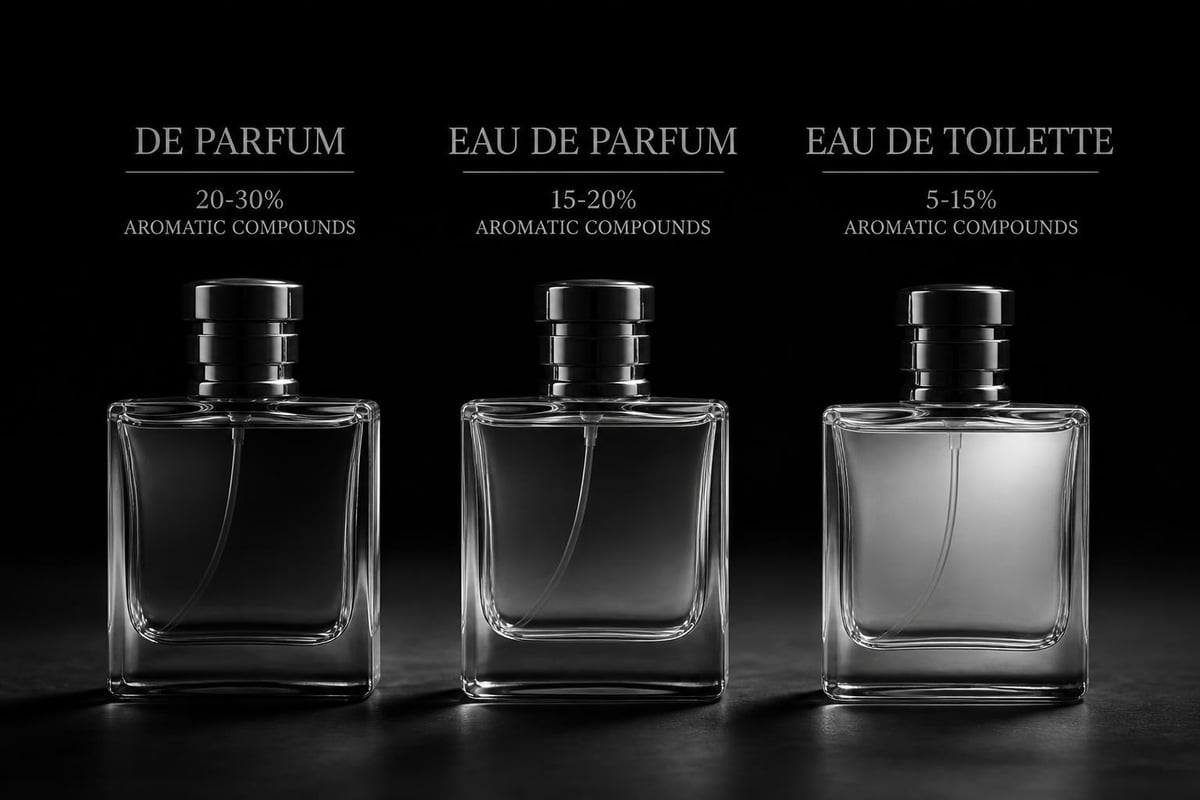
The base composition differs between these two strengths. Traditional alcohol-based fragrances use ethanol as the carrier, with IFRA standards governing concentration limits for different product categories. Oil-based formulations, like those found in botanical eau de parfum created with natural plant extracts, avoid alcohol entirely while maintaining concentration distinctions through the ratio of aromatic material to carrier oil.
How concentration affects scent development
De perfume unfolds slowly across 8-12 hours or longer. The high concentration of aromatic molecules creates a dense scent structure where top, heart, and base notes blend more seamlessly rather than presenting as distinct phases.
Eau de toilette develops faster and more distinctly. You smell the bright top notes immediately after application, the heart emerges within 15-30 minutes, and the base becomes apparent after 2-3 hours. The entire cycle completes within 4-6 hours for most compositions.
| Aspect | De Perfume | Eau de Toilette |
|---|---|---|
| Concentration | 20-40% | 5-15% |
| Longevity | 8-12+ hours | 4-6 hours |
| Projection | Intimate, close to skin | Moderate, noticeable at arm's length |
| Price per ml | Highest | Moderate |
| Applications needed | 1-2 dabs | 3-5 sprays |
| Best for | Evening, special occasions, dry skin | Daily wear, warm weather, oily skin |
Which lasts longer: de perfume or eau de toilette?
De perfume lasts 8-12 hours or more on skin due to its high concentration of aromatic compounds and slower evaporation rate, while eau de toilette typically lasts 4-6 hours before requiring reapplication. Skin type, climate, and application method also influence longevity for both formulations.
The molecular weight of fragrance compounds plays a significant role. Heavier molecules found in base materials evaporate more slowly, and de perfume formulations contain a higher ratio of these persistent compounds. Research on fragrance molecule stability shows how oxidation and evaporation rates vary based on concentration and carrier composition.
Application technique matters more with de perfume vs eau de toilette. For de perfume, apply to pulse points where skin remains warm: inner wrists, behind ears, base of throat. The heat gently diffuses the scent without overwhelming. For eau de toilette, spray into air and walk through the mist, or apply to clothing and hair in addition to skin for extended presence.
Skin chemistry and longevity
Dry skin absorbs fragrance faster, shortening wear time for both concentrations. Moisturized skin holds scent longer as the oils create a barrier that slows evaporation. People with naturally oily skin often find eau de toilette sufficient, while those with dry skin benefit from de perfume's density.
pH levels on your skin surface affect how fragrance molecules interact with natural oils and sweat. The same de perfume may last 6 hours on one person and 14 hours on another based purely on individual skin chemistry. Testing both concentrations on your own skin remains the most reliable method for predicting performance.
Climate impacts longevity significantly. Heat accelerates evaporation, making eau de toilette fade faster in summer months or tropical environments. Cold weather slows molecular movement, extending the wear time of lighter concentrations while making de perfume feel less projective.
How do you apply de perfume differently than eau de toilette?
Apply de perfume sparingly to pulse points using 1-2 dabs or drops, while eau de toilette requires 3-5 sprays to chest, neck, wrists, and optionally hair or clothing for adequate scent presence. Over-application of de perfume creates an overpowering experience that can cause olfactory fatigue.
The application method differs by format. De perfume traditionally comes in splash bottles or rollerballs rather than spray atomizers. This design encourages controlled application. You touch the applicator to skin briefly, allowing capillary action to transfer a small amount of liquid. Dabbing rather than rubbing preserves the fragrance structure.
For eau de toilette, the spray mechanism creates a fine mist that disperses over a larger surface area. Hold the bottle 6-8 inches from skin and apply one spray per target area. Layering across multiple zones creates dimension without concentrating too much scent in one location.
Strategic application zones:
- Pulse points: Inner wrists, behind ears, base of throat where blood vessels sit close to skin surface
- Heat zones: Chest, inside elbows, behind knees where body warmth activates scent
- Hair and fabric: For eau de toilette only, as these surfaces release scent gradually without metabolizing it
Reapplication timing varies. Eau de toilette benefits from a midday refresh, typically 4-6 hours after initial application. De perfume rarely needs reapplication during a single day. Evening events may warrant a fresh dab, but morning application usually carries through to bedtime.
Does de perfume cost more than eau de toilette?
De perfume costs 40-100% more per milliliter than eau de toilette from the same fragrance line due to higher concentrations of expensive aromatic raw materials and smaller production batches. However, cost per wearing often equalizes since de perfume requires less product per application and fewer reapplications throughout the day.
Raw material costs drive pricing structure. Rare botanical extracts, aged resins, and complex isolates appear in higher proportions in de perfume formulations. A composition requiring 30% fragrance oil uses three times the raw materials of one formulated at 10% concentration for eau de toilette.
Production batch sizes affect per-unit cost. Eau de toilette sells in higher volumes, allowing manufacturers to achieve economies of scale. De perfume remains a specialty purchase, produced in smaller quantities with higher overhead costs distributed across fewer units. Cosmetic safety assessment processes also require more extensive documentation for higher-concentration products.
Value calculation over time
Consider usage rate when evaluating cost. A 30ml bottle of de perfume applied with one dab per wrist daily provides approximately 150-180 wearings. A 50ml eau de toilette requiring four sprays per application provides roughly 250-300 wearings, but you may need to reapply during the day, effectively halving the number of wear days.
Bottle size options differ between concentrations. De perfume often comes in smaller formats (7.5ml, 15ml, 30ml) reflecting the product's potency. Eau de toilette typically starts at 30ml and commonly appears in 50ml, 100ml, or larger bottles designed for frequent, generous application.
| Volume | De Perfume Price Range | Eau de Toilette Price Range | Applications per Bottle |
|---|---|---|---|
| 15ml | $85-$200 | Not common | 75-90 (perfume) |
| 30ml | $150-$350 | $60-$120 | 150-180 (perfume), 60-75 (toilette) |
| 50ml | $225-$500 | $80-$180 | 250-300 (perfume), 100-125 (toilette) |
Which concentration works better for daily wear?
Eau de toilette works better for daily wear in most professional and casual settings due to its moderate projection, lighter feel, and shorter commitment time, while de perfume suits special occasions, evening events, or situations where you want an intimate scent signature. Personal preference and workplace culture ultimately determine the best choice.
Office environments often have fragrance policies or unwritten expectations about scent intensity. Eau de toilette provides enough presence to feel groomed without creating a scent cloud that affects colleagues in shared spaces. The shorter wear time also means any application errors fade by afternoon rather than lingering all day.
Lifestyle factors influence which concentration serves you better. Active routines involving exercise, outdoor activities, or multiple outfit changes throughout the day pair well with eau de toilette's renewable nature. Sedentary or climate-controlled environments where you remain in one setting for extended periods allow de perfume to develop fully without interference.
Daily wear considerations:
- Morning commute exposure to crowds and confined spaces
- Workplace ventilation and proximity to colleagues
- Planned activities involving heat, moisture, or physical exertion
- Need for scent presence during evening plans after work
- Budget for regular fragrance replenishment
Social settings have different scent expectations. Intimate gatherings, date nights, or formal events welcome the complexity and longevity of de perfume. Casual meetups, outdoor festivals, or daytime events suit eau de toilette's lighter, more approachable character.
How does alcohol content differ between de perfume and eau de toilette?
Traditional de perfume contains 20-30% alcohol with the remainder being fragrance oil and fixatives, while eau de toilette contains 70-85% alcohol with fragrance oil making up just 5-15% of the composition. Alcohol-free formulations exist in both concentrations, using carrier oils or other bases, particularly in botanical and natural perfumery.
The alcohol percentage affects texture and application feel. High alcohol content in eau de toilette creates an immediate cooling sensation upon contact with skin, followed by rapid evaporation that disperses scent molecules into the air around you. This creates projection but also accelerates the scent's dissipation.
Lower alcohol in de perfume produces a denser, more oil-like texture that sits on skin surface longer before absorbing. Some de perfume formulations contain no alcohol whatsoever, relying on high-quality carrier oils or pure aromatic compounds. Understanding fragrance product categories helps explain why concentration standards evolved alongside carrier composition.
Alcohol impacts scent development speed. The volatile nature of ethanol launches top notes immediately after application, creating that first impression burst. In eau de toilette, this happens aggressively because of the high alcohol ratio. In de perfume, the slower alcohol evaporation or absence of alcohol entirely means the composition unfolds more gradually.
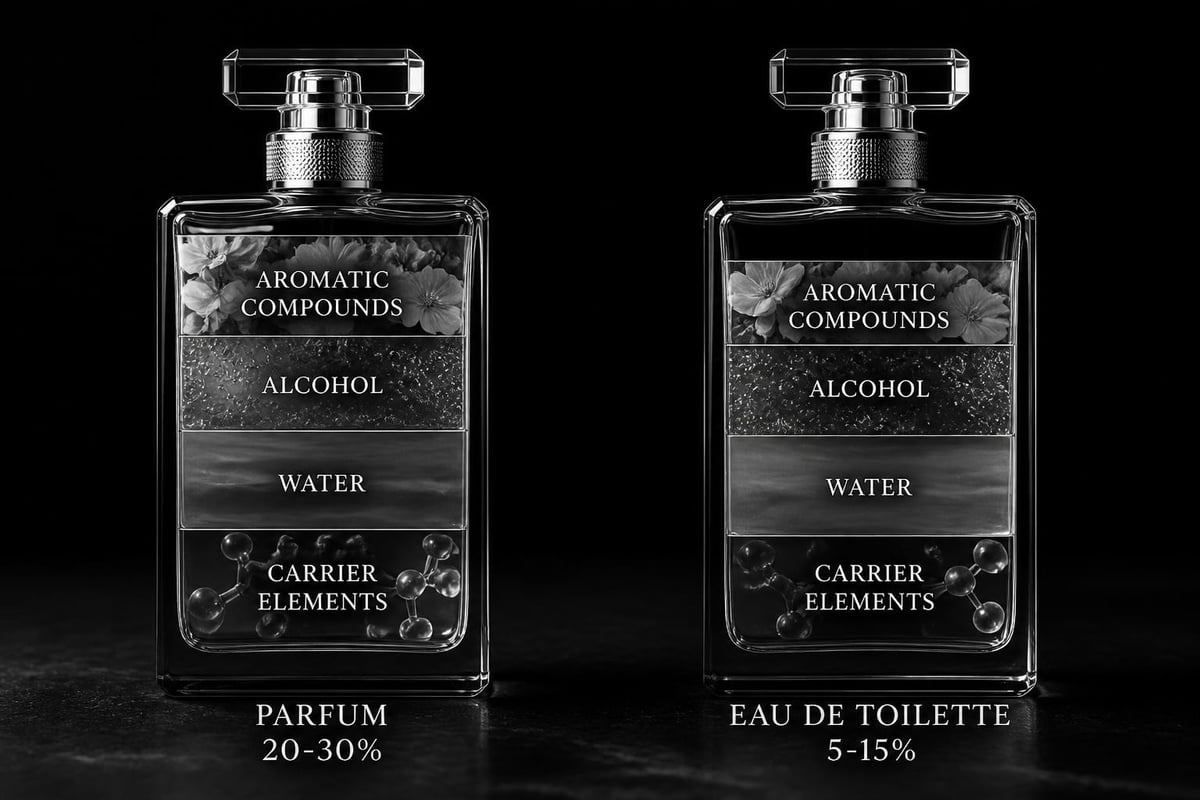
Alternative carrier systems
Oil-based perfumes eliminate alcohol entirely, using jojoba, fractionated coconut oil, or other botanical carriers. These formulations exist at various concentrations comparable to de perfume or eau de parfum strength. The botanical eau de parfum approach uses plant and resin extracts in oil bases, creating alcohol-free compositions with strong scent presence.
Water-based formulas represent another alcohol-free option, though less common. These use water and solubilizers to disperse fragrance oils, creating a very light spray that works similarly to eau de toilette but without alcohol's drying effect. Performance typically falls between eau de toilette and cologne strength.
Solid perfumes concentrate fragrance oils in wax or balm bases. While they don't fit the de perfume vs eau de toilette classification exactly, their concentration levels often match or exceed de perfume strength at 20-40% fragrance load in the wax matrix.
Can you layer de perfume and eau de toilette together?
You can layer de perfume and eau de toilette from the same fragrance line to customize intensity and longevity, applying de perfume to pulse points first for depth, then finishing with eau de toilette spray for projection. However, layering different fragrances requires careful selection of complementary compositions to avoid creating a discordant combination.
The technique works best when using the same scent in different concentrations. Apply de perfume to lower pulse points (inner wrists, behind knees) where it will develop slowly throughout the day. Follow with eau de toilette to upper body, hair, and clothing for immediate presence. As the eau de toilette fades after 4-6 hours, the de perfume foundation continues providing scent.
Cross-fragrance layering demands more skill. Select compositions that share similar base accords or complementary families. Testing combinations on skin before wearing them publicly prevents unfortunate discoveries. Keep a layering journal noting successful and unsuccessful pairings.
Successful layering approaches:
- Same fragrance, different strengths: Most reliable method with predictable results
- Shared accords: Two fragrances with common base materials like amber or wood
- Linear progression: Light citrus eau de toilette over warm resinous de perfume
- Seasonal adjustment: Add freshness to heavy de perfume with bright eau de toilette
Some perfume houses create layering collections specifically designed to work together. These take the guesswork out of combining multiple scents. If exploring natural options like those from Haus of Smell, their botanical formulations layer well because they share a consistent oil-based structure and plant-derived ingredient philosophy.
What regulations govern de perfume vs eau de toilette labeling?
Fragrance products must comply with regional cosmetic regulations that govern labeling, allergen disclosure, and concentration terminology, with EU regulations particularly detailed about allergen labeling requirements for different perfume strengths. The terms "de perfume" (or parfum/extrait) and "eau de toilette" themselves are not legally defined concentration thresholds but industry conventions.
In the European Union, cosmetic regulations require disclosure of 26 known fragrance allergens when present above certain thresholds. These thresholds differ for products left on skin versus rinsed off, affecting how de perfume and eau de toilette must be labeled. Research on fragrance allergen analysis demonstrates how testing methods verify compliance with labeling requirements.
The United States regulates fragrances as cosmetics under FDA jurisdiction, with less specific concentration labeling requirements than Europe. Manufacturers must list ingredients, but the fragrance formula itself can be protected as proprietary and listed simply as "fragrance" or "parfum" without breaking down individual aromatic compounds.
Fragrance sensitization research informs regulatory decisions about concentration limits and exposure. Higher concentrations may require additional stability testing, particularly for compounds prone to oxidation that can generate new allergens over time.
Terminology standards across markets
French terminology remains standard internationally: "parfum" or "extrait de parfum" for highest concentration, "eau de parfum" for strong concentration, "eau de toilette" for moderate concentration, and "eau de cologne" for light concentration. These terms appear on products sold globally regardless of local language.
Some brands create proprietary concentration names ("intense," "absolute," "elixir") that don't correspond to traditional categories. These require careful examination of actual fragrance oil percentage, usually not disclosed on packaging but sometimes available through customer service or editorial fragrance guides.
Vegan and natural certifications add another labeling layer. Products claiming "100% botanical" or "alcohol-free" must substantiate these claims through ingredient transparency. When exploring botanical fragrance options, verify that both the aromatic compounds and carrier base meet natural standards, not just one component.
Does skin type affect how de perfume vs eau de toilette performs?
Skin type significantly affects fragrance performance, with dry skin absorbing both de perfume and eau de toilette faster (requiring reapplication sooner), while oily skin extends longevity for both concentrations and may make eau de toilette perform similarly to de perfume on normal skin. Understanding your skin's oil production, pH, and moisture retention helps predict which concentration will work best.
Sebum production creates a lipid barrier on skin surface. This natural oil layer holds fragrance molecules, slowing their evaporation. People with naturally oily skin often find that eau de toilette provides 6-8 hours of wear, approaching de perfume performance. Those with dry skin may experience only 2-3 hours from eau de toilette before it becomes imperceptible.
Skin pH varies between individuals, typically ranging from 4.5 to 6.5. This acidity level affects how fragrance molecules interact with your skin's chemistry. Some aromatic compounds intensify in acidic environments while others fade faster. The same de perfume may smell quite different on two people purely because of pH variation.
Skin type recommendations:
- Very dry skin: De perfume or oil-based formulations that add moisture while scenting
- Dry to normal skin: De perfume for longevity, eau de toilette with moisturizer prep
- Normal to oily skin: Either concentration works well, choose based on intensity preference
- Very oily skin: Eau de toilette often sufficient, de perfume may become overwhelming
Temperature regulation differs by individual. People who run warm or perspire more heavily may find that heat amplifies both de perfume and eau de toilette beyond comfortable levels. Starting with eau de toilette allows for testing scent response to your body chemistry before investing in concentrated versions.
How do you store de perfume and eau de toilette properly?
Store both de perfume and eau de toilette in cool, dark, stable environments away from direct sunlight, heat sources, and humidity to preserve fragrance integrity, keeping bottles sealed tightly between uses to prevent oxidation and evaporation. De perfume requires slightly more careful storage due to its higher concentration of volatile compounds that can degrade with improper handling.
Light exposure degrades fragrance molecules through photochemical reactions. UV rays break down aromatic compounds, causing the scent to smell different from its original composition. Amber or opaque glass bottles provide better protection than clear glass, but even these should remain away from windows and bright artificial light.
Temperature fluctuations stress fragrance formulations. Repeated heating and cooling causes expansion and contraction that can compromise bottle seals and accelerate oxidation. Bathrooms represent the worst storage location despite their convenience, as shower steam and temperature swings create hostile conditions.
Optimal storage conditions:
- Temperature: 60-70°F (15-21°C), consistent rather than fluctuating
- Light: Dark closet, drawer, or cabinet away from windows
- Humidity: Below 60% relative humidity to prevent cap corrosion and seal degradation
- Position: Upright storage prevents fragrance contact with metal or plastic components in spray mechanisms
Oxygen exposure through repeated opening and air space in partially used bottles accelerates deterioration. Consider decanting de perfume into smaller bottles as you use it, keeping the remaining product in a filled container with minimal air space. Eau de toilette faces less oxidation risk due to higher alcohol content acting as preservative, but proper storage still extends its usable life.
Shelf life varies between concentrations and formulations. Alcohol-based fragrances typically remain stable for 3-5 years when properly stored. Oil-based formulations like those used in botanical perfumery may have shorter shelf lives of 1-3 years depending on the stability of natural ingredients, though some improve with age like fine oils or wines.
FAQ
What is the main difference between de perfume and eau de toilette?
The main difference lies in concentration: de perfume contains 20-40% fragrance oils while eau de toilette contains 5-15%. This concentration difference affects longevity, intensity, price, and application method. De perfume lasts longer with fewer applications needed, while eau de toilette provides lighter presence requiring reapplication. Both serve different purposes depending on occasion, preference, and budget considerations for daily or special use.
Can you wear de perfume every day?
You can wear de perfume daily, though most people reserve it for special occasions due to its intensity, higher cost per application, and extended presence. Daily de perfume wearing works well if you prefer strong, long-lasting scent and can apply it sparingly. One dab to pulse points provides sufficient coverage for all-day wear. Consider workplace environment and close-contact situations when deciding whether de perfume suits your daily routine and social settings.
How many sprays of eau de toilette should you use?
Use 3-5 sprays of eau de toilette for adequate scent presence without overwhelming yourself or others nearby. Apply one spray each to pulse points: neck, chest, and wrists. For extended wear, add one spray to hair or clothing. More sprays don't proportionally increase longevity; they just intensify the initial projection. Adjust based on specific formulation strength, as some eau de toilette blends perform stronger than others within the category.
Is de perfume better for sensitive skin than eau de toilette?
De perfume may be better for alcohol-sensitive skin if choosing an oil-based formulation, but alcohol-based de perfume can irritate sensitive skin more than eau de toilette due to higher concentration of fragrance compounds. Fragrance allergen studies show sensitization risk increases with concentration and exposure frequency. Patch testing any concentration on inner arm before full application helps identify reactions. Alcohol-free botanical formulations eliminate ethanol irritation while maintaining fragrance strength.
Why does eau de toilette smell different than de perfume from the same line?
Eau de toilette emphasizes top notes due to higher alcohol content creating immediate volatile diffusion, while de perfume balances all notes more evenly with slower development. Perfumers sometimes adjust formulations between concentrations to account for performance differences, adding more top notes to eau de toilette or more base to de perfume. The same aromatic compounds behave differently at various concentration levels, causing the perceived scent to shift even when the formula ratios remain proportionally identical.
How do you know which concentration to buy when trying a new fragrance?
Start with eau de toilette when testing unfamiliar fragrances, as the lower cost and lighter concentration reduce commitment if the scent doesn't suit you. Once confident you enjoy a particular fragrance, consider de perfume for special occasions or if you want maximum longevity. Request samples or visit boutiques like Haus of Smell's Manhattan location where you can experience different concentrations on your skin before purchasing full bottles.
Understanding the distinction between de perfume vs eau de toilette empowers you to select the right concentration for your needs, whether prioritizing longevity, intensity, budget, or occasion-appropriate presence. At Haus of Smell, we craft botanical perfumes in Manhattan using 100% natural, alcohol-free, vegan formulations that deliver concentrated scent without synthetic compounds. Visit our NoMad studio to experience how plant-based fragrance oils create lasting impressions without the compromises of conventional perfumery.